Rebel Tech Podcast Ep. 17: Laura Davis on AI and Government
Laura Davis joins TPPF's Rebel Tech Podcast to discuss the frustration that led her to co-found USLege and where AI in government goes next.
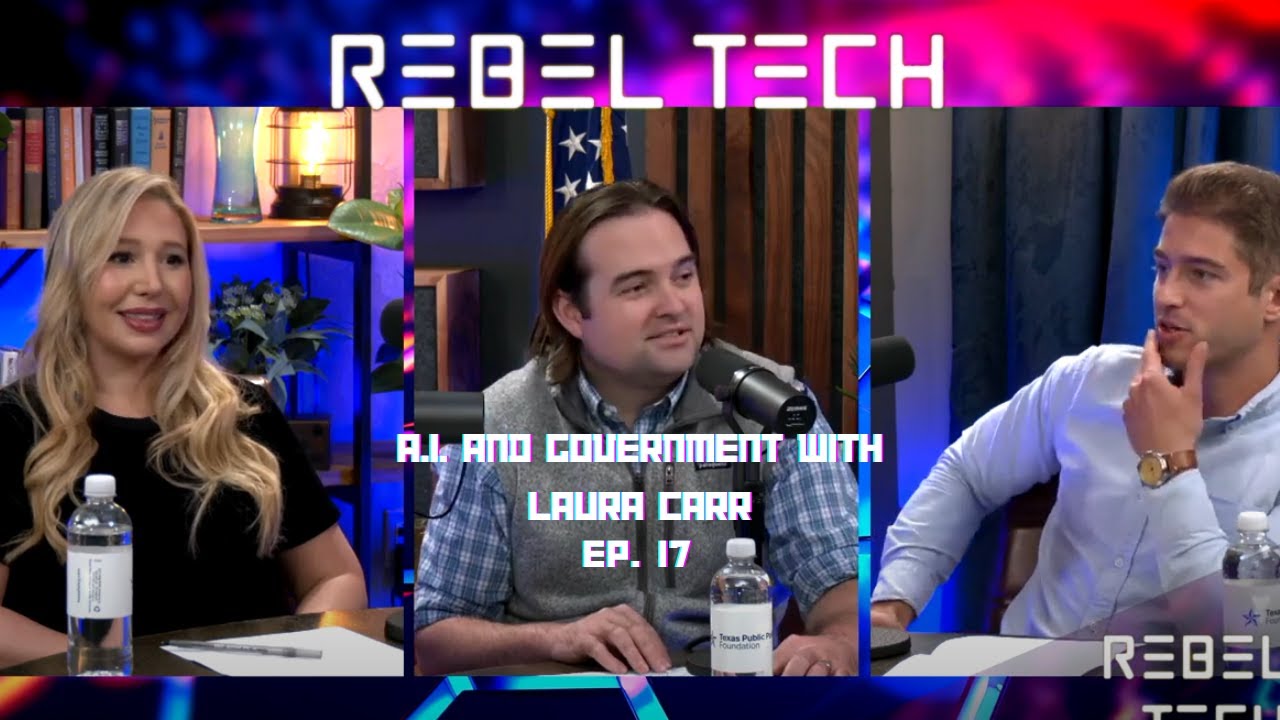
In January 2025, USLege co-founder Laura Davis (credited under her former name, Laura Carr, in the original episode) sat down with hosts Zach Whiting and David Dunmoyer for Episode 17 of the Texas Public Policy Foundation's Rebel Tech Podcast. Both hosts know Laura from having "fought in the trenches" with her in the Texas Capitol before she left the lobbying and Senate world to build USLege, which makes this less of a cold-open interview and more of a conversation between people who watched the problem happen in real time. The full episode is worth watching — you can find it on texaspolicy.com or YouTube.
What the conversation covered
The episode traces Laura's path from a political science student at the University of Alabama, to Capitol Hill staff roles, to the U.S. Chamber of Commerce and No Labels, to Texas government relations and lobbying, and eventually to a policy role in the Texas Senate. That last stretch — sitting inside session, watching how bills actually move — is where the idea for USLege took shape. The hosts push her on the entrepreneurial leap itself: what made her decide to build the tool rather than wait for someone else to. Laura walks through the early customer discovery process (talking to hundreds of prospective users, including the show's own hosts), the MVP that convinced her the product had found real fit, and how she met her two co-founders — her husband Eric Davis, who spent eight years in Silicon Valley startups, and technical co-founder Ben Brewer, whom she found through a Y Combinator matching program.
From there the discussion moves into what USLege actually does — legislative tracking and a legislative CRM built to handle a session where Texas alone can see roughly 20,000 bills filed in six months, more than the federal government files in a full year — and why that scale and speed problem is exactly what makes Texas the hardest, and therefore best, place to build the software first.
Verbatim quotes
On the frustration that pushed her to start building:
"There were times where I was on Capitol Hill and I'd be formatting something and think, I'm taking hours doing this knowing that this is going to be automated one day... the big straw was during session I started seeing large language model potential and got really excited because there's just too many databases of really important information."
On what USLege is, in her own words:
"In short we're a legislative tracking software and legislative CRM that allows you to keep track of legislation, everything from committee hearings to floor debates to state agency meetings."
On why she brought her husband in as a co-founder:
"Co-founder is Eric Davis, and he worked in startups — he worked in Silicon Valley for eight years... I said, I think that we can build something here."
On the company's core value, "ride the tiger":
"Hold on for dear life, it's going to be a wild ride, and you are going to just plow through those challenges and celebrate all the wins — but hold on for dear life."
On why she's optimistic about AI rather than worried by it:
"I think it can be used in a way to get your life back and not spend as much time behind a computer screen, and that was one of the big reasons I wanted to start our company."
Why it matters for government affairs teams
For anyone running a government affairs, lobbying, or policy shop, the through-line of this episode is a familiar one: the amount of legislative information that matters is growing faster than any team's ability to manually track it. Laura's description of trying to keep up with thousands of bills, committee substitutes, and hearing testimony by hand is not a hypothetical — it's the daily reality for one-person policy shops and large multi-issue firms alike, just at different scales. The conversation is a useful reminder that the goal of applying AI to this work isn't to replace the relationship-driven, in-the-room part of advocacy, but to free up the hours currently spent on manual formatting, transcription, and bill-hunting so that time can go toward the conversations that actually move legislation. It's also a candid, unpolished founder story — the kind that's useful context for any customer or prospect wondering who built USLege and why.
Listen to the full conversation on texaspolicy.com or YouTube for more, including her take on sci-fi, why Austin's startup culture is different from the Bay Area or Seattle, and her answer to whether USLege belongs on the federal DOGE commission's radar.