AI and the Future of Lobbying: USLege on Corner Alliance
USLege co-founders join Corner Alliance to unpack how AI is reshaping lobbying, transparency, and legislative advocacy across government.
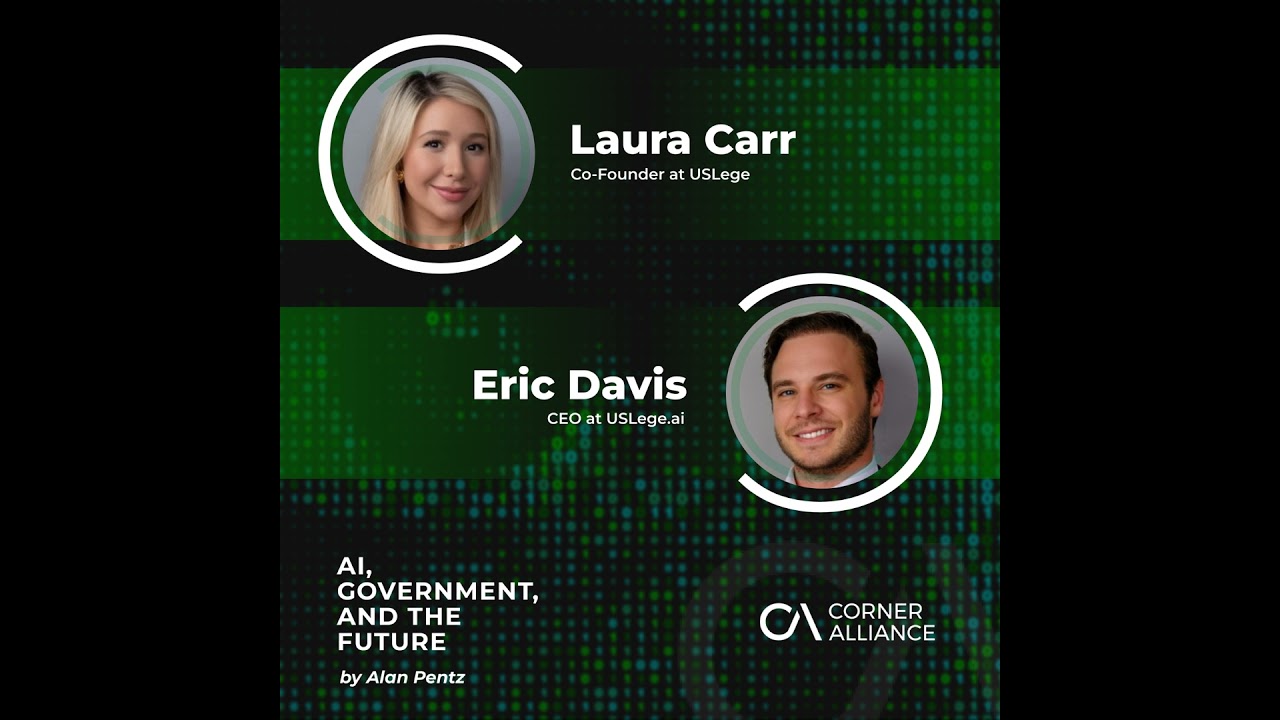
USLege co-founders Laura Davis (credited in this episode under her former name, Laura Carr) and Eric Davis sat down with host Max Romanik for Corner Alliance's podcast, AI, Government, and the Future, to talk about how artificial intelligence is changing the practice of lobbying and government relations. The full conversation is worth a listen — watch it on YouTube or Spotify.
What the conversation covered
The episode traces the USLege origin story from two different vantage points. Laura spent 12 years inside Texas politics — in the building, lobbying, fundraising, and eventually serving as policy director in the Texas Senate and government relations director and scheduler to Governor Greg Abbott. Eric came from the startup world, building his fourth company from zero to one, with no political background at all. Together they describe how the frustration of trying to track thousands of bills in a six-month legislative session, with no centralized transparency into what was actually happening in committee, became the founding problem USLege set out to solve.
From there, the discussion moves through several themes: how AI can give lobbyists and advocates faster access to information so they can spend more time on the human, relationship-driven side of advocacy; how customization and "walled garden" data separation let organizations on opposite sides of an issue — even opposing sides of Texas's school choice debate — use the same platform without their data or positions ever crossing; and how AI might expand access for smaller nonprofits, students, and under-resourced advocacy groups that can't afford a policy team or a large lobbying operation.
They also talk candidly about risk: the dangers of proprietary data training a public model (illustrated by a partner's gin-distillery ad that ended up recreated by a general-purpose AI tool), the near-impossibility of real-time regulation keeping pace with the technology, and the importance of transparency around election and campaign finance data as the 2024 presidential election approached.
Verbatim quotes
On the frustration that led to founding USLege, Laura explained:
"There's really nothing tracking what was going on and no transparency into some of these really large bills and complex legislation... AI made a lot of things possible that were previously impossible."
Laura also described how fast legislation can shift underneath advocates in the room:
"We had a bill that looked good, I knew everything about it, and then an hour before the hearing there was a committee substitute — the bill completely changed, and everybody who was there to testify didn't know what to testify on anymore because the bill changed so much and they didn't have time to read it."
On why USLege keeps each customer's data and positions strictly separated, even when customers are on opposite sides of the same fight, Eric said:
"We have to make sure there's also an ironclad — you know, walled garden is what we internally call it — to make sure there's no bleeding over from one customer to another customer, because that can cause massive, massive issues. We would be out of there pretty quickly if we did do that."
On AI's potential to level the playing field for smaller, less-resourced advocacy groups, Eric added:
"What is AI? It's cheap information. If you can give smaller advocacy groups that got all the passion but a little bit less of the funding, then it can give them access to the information they wouldn't have otherwise."
And on how the platform handles bias rather than pretending it doesn't exist, Laura noted:
"That's how we really do keep a lot of the bias out of how we train our model... it's in a way almost your own bias — you choose what that is, you choose your slant on an issue, and then that's what the AI is going to help you achieve."
Why it matters for government affairs teams
The conversation is a useful primer for any government affairs or public policy team wondering how AI fits into their work. The core argument USLege makes — that speed and access to information should free up more time for the human, persuasive side of advocacy, not replace it — is a grounded counterpoint to fears that AI will hollow out relationship-driven lobbying. The walled-garden approach to customer data is also a reminder of what to look for in any AI tool touching sensitive legislative strategy: your positions and your data should stay yours, even when a competitor or opposing advocacy group uses the same platform. For teams evaluating AI tools for legislative tracking, it's a candid look at both the opportunity and the guardrails that matter.