By Jeff Blaylock - Founder & Senior Editor
August, 16, 2024
We begin the final sprint to Election Day with many things already known, or all but certain, and can speculate on some down-ballot impacts of the changing presidential race.
State Legislative Control Unlikely to Shift
The state House and Senate will remain solidly in Republican hands. Enough House seats are rated Safe Republican (47) or Likely Republican (30) to clinch the majority even if Democrats were to sweep everything else. Republicans should win most of the collective seats rated Lean Republican (8) and Toss Up (3), and the party should pickup at least one Democrat-held seat. We rate open HD80, where longtime Rep. Tracy King (D) is not seeking re-election, as Likely Republican. We have HD74, which is being defended by Rep. Eddie Morales, rated Lean Republican.
Any change in statewide leadership will thus depend on two factors outside the voters’ power. In the House, it would require the members to elect a different leader over Speaker Dade Phelan, Gov. Abbott, and Lt. Gov. Patrick are not on the ballot this year and will remain in those positions unless a second Trump presidency results in one or both being tapped for federal positions. If this were to happen, it would likely happen during the legislative session. This would also apply to other statewide offices if any of them were chosen by Trump to serve in his administration.
Potential Impact of Harris at the Top of the Ballot
Replacing President Biden with Vice President Kamala Harris at the top of the ballot will have no tangible impact at the state level, but it could have intangible impacts that affect the margins. According to the most recent Texas Politics Project poll, Biden (39/53) and Harris (35/51) had nearly the same approval ratings. Importantly, Harris has nearly the same strong negatives as Biden but slightly lower positives.
The table compares the favorability ratings of Biden, Harris and former President Trump split out by key voting groups. The numbers in parentheses are the percentage of poll respondents who said their approval and disapproval was strong.
Group
Biden
Harris
Trump
Overall
39/53 (20/44)
35/51 (15/43)
45/49 (20/41)
Independents
20/66 (4/55)
18/58 (2/50)
31/59 (16/50)
Women
38/51 (19/42)
35/49 (14/41)
52/42 (36/35)
Black voters
67/21 (36/14)
64/19 (33/12)
28/65 (15/59)
Hispanic voters
41/47 (21/35)
41/42 (17/34)
37/53 (26/45)
Ages 18-29
50/33 (24/18)
47/23 (15/12)
38/50 (20/39)
4yr college degree
41/51 (23/43)
37/49 (17/41)
42/51 (27/41)
Suburban
39/55 (20/46)
37/54 (17/48)
43/51 (27/45)
Keep in mind that dividing respondents into these groups greatly decreases the poll’s sample size and thus greatly increases the margin of error. With that in mind, any ratings split between Biden and Harris could be non-existent. However, Harris was not the nominee when this poll was conducted, so she may rise or fall compared to Biden as voters learn more about her as the Democratic nominee.
Harris's Potential to Boost Voter Turnout
Harris may have intangible impacts on the state’s voters. Early indications point to increased optimism among Democrats compared to having the ticket led by Biden, and this could translate into marginal improvements in get out the vote efforts. We may also see an increase in turnout among urban and younger voters – two key blocs of voters for Democrats whose turnout typically lags compared to other groups. However, it is unlikely that Harris will be able to duplicate the surge in turnout created by former President Obama’s candidacy in 2008.
Limited Impact on Statewide and Competitive Races
Any Harris-related impacts will not be enough to flip the state’s electoral votes or change the outcome of statewide races, but they could affect competitive legislative and congressional races. Such impacts will be highly limited and localized. There are simply far too few competitive races. A total of 17 legislative and congressional races are rated as Lean Republican, Lean Democrat or Toss Up out of the 203 on the ballot. One other race – Democrat-held HD80, noted above – is likely to flip, so we will include it here.
All 18 of these districts are projected to be more Democratic than the state as a whole, but not enough for Democratic candidates to prevail in most of them. All but one of them has moved more than 5 points towards one party or the other since 2016:
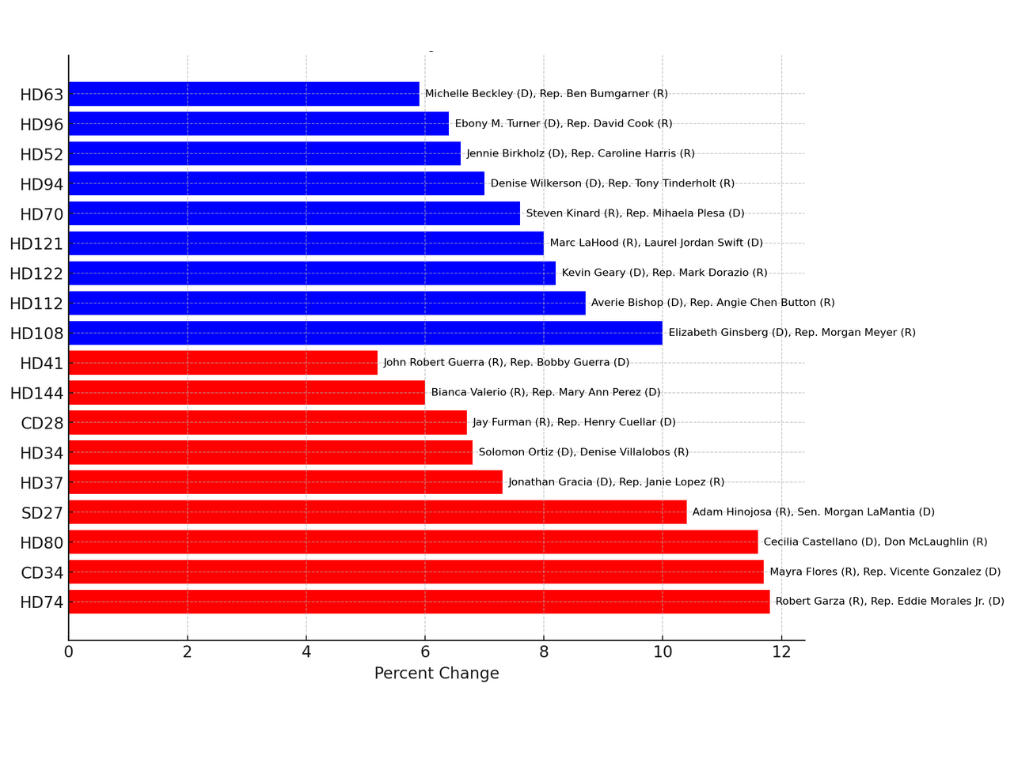
Electorate Shift Since 2016
Note: This chart includes HD144, which would be rated as Lean Democrat except that Rep. Mary Ann Perez is unopposed.
The lone exception among the competitive seats is HD118, where Rep. John Lujan (R) is seeking re-election against Kristian Carranza. This district has moved less than 1% toward Democrats since 2016.
The geographic distribution of these shifts is notable and expected. All the competitive seats becoming more favorable to Republicans are in South Texas and the Coastal Bend. All the competitive seats becoming more favorable to Democrats are in the suburbs surrounding Dallas, Fort Worth, Austin and San Antonio.
Don’t discount the possibility that Harris’s candidacy also energizes lower turnout blocs of Trump supporters in the state generally and these districts in particular.
Will Key Issues Motivate Voters to the Polls?
While immigration and border issues remain strong motivators for Republican voters, the big question for this election is the extent to which abortion access and women’s issues are or remain strong motivators for Democrats. The latest Texas Politics Poll revealed:
- 48% of respondents strongly oppose preventing Texas women from accessing abortion in others states where it is legally available
- 46% strongly oppose preventing women from obtaining “medicated abortion pills”
- 47% strongly oppose penalizing Texas companies that pay for employees to travel to other states to obtain an abortion; and
- 57% strongly oppose preventing women from using IVF procedures.
Group
Restrict Travel to Other States
Prohibit Abortion Pills
Penalize Texas Businesses
Prohibit Access to IVF
Overall
24/63 (11/48)
28/62 (16/46)
28/60 (16/47)
16/68 (7/57)
Independents
12/74 (7/58)
22/65 (10/51)
16/69 (11/57)
15/66 (7/56)
Women
24/65 (12/50)
26/64 (15/49)
25/62 (15/49)
14/70 (6/60)
Black voters
17/71 (8/58)
17/72 (7/59)
15/70 (6/58)
16/71 (8/64)
Hispanic voters
31/58 (13/45)
28/62 (19/45)
26/62 (16/47)
20/59 (7/47)
Ages 18-29
39/52 (15/41)
32/58 (19/41)
37/54 (16/41)
23/56 (9/47)
4yr college degree
21/70 (12/53)
28/64 (15/50)
28/61 (15/51)
13/74 (6/60)
Suburban
20/70 (10/56)
24/68 (14/53)
26/64 (15/53)
12/75 (5/65)
Same caveats about smaller sample sizes and larger errors in the split-out groups, but it is clear such policies have some pretty high negatives, particularly denying access to IVF, particularly among suburban voters and voters with 4-year college degrees. These are key voting blocs in the suburban districts that have been trending more Democratic, so a case can be made that some of those Republican-held competitive seats could see a big enough movement to flip them.
Turnout should be on the higher side as this state goes, but neither party will particularly benefit from it, unless Harris the candidate is closer in appeal to Obama than Biden.
Buckle your seat belts. It’s going to be a rough ride.
This post has been updated to correct an error.
Meet The Author
Jeff Blaylock, Founder and Senior Editor brings over 25 years of political expertise, encompassing analysis, campaign management, government service, and advocacy. With a focus on Texas elections and legislative processes, Jeff's career includes roles such as Chief Committee Clerk for the Texas House of Representatives' State Affairs and Financial Institutions Committees.
His leadership ensured no point of order was sustained against committee legislation.
Jeff also served as a policy and budget analyst at the White House's Office of Management and Budget and the U.S. Department of Veterans Affairs, in addition to various management roles in national political campaigns. He began sharing his election insights in 2005, publishing Texas Election Source for nearly a decade. Jeff's comprehensive understanding of public policy and its impact on elections was honed during his tenure as Managing Director at Public Strategies (now Hill+Knowlton Strategies), where he advised clients on legislative strategies, public affairs, crisis communication, and brand reputation.
He holds a Bachelor's degree in journalism with a political science minor from Texas Christian University and a Master's in public policy from Georgetown University. Currently, Jeff serves as the VP of Client Services at Kith, a leading crisis management consulting firm.
🎙️We Have a Podcast! 🎙️
Bills and Business is your go-to podcast for conversations related to Texas legislation and business. Hosted by Laura Carr, Co-Founder of USLege—an AI-driven legislative tracking software—we bring you in-depth analysis on economic trends, impactful legislation, and key developments shaping Texas business.
Subscribe on Youtube and Spotify for weekly episodes!

- 01 First
Subscribe to our Newsletter

Read more news

Texas Political Spotlight

Welcome back, friends
Texas is facing a pivotal legal test over its election system as Republicans seek to end open primaries, a move that supporters frame as protecting party autonomy and critics warn could create new barriers to voter participation. At the same time, federal officials are considering a land exchange that would allow SpaceX to expand its South Texas launch site, renewing debate over how to balance economic growth with the preservation of sensitive wildlife habitat along the Gulf Coast. Lastly, a federal judge has blocked a new Texas law regulating children’s access to app stores, underscoring the ongoing uncertainty over how far states can go in policing online safety without infringing on constitutional rights.
.jpeg)

.jpeg)
We hope you enjoyed today’s read!
#44 - Hope Osborn: Building Community for Women in Texas Politics with Pink Granite
Welcome to Episode #44 of Bills & Business. In this episode, Laura Carr, Co-Founder of USLege, sits down with Hope Osborn, Co-Founder of The Pink Granite Foundation.
Hope brings more than a decade of experience across the Texas Capitol, having worked in both chambers, both parties, and in the advocacy world. She shares the story behind The Pink Granite Foundation and how it has grown into a nonpartisan force for uplifting, connecting, and supporting women in Texas politics. From its grassroots beginnings to the impact of the 2025 Pink Granite Party, Hope provides an inside look at how the organization strengthens the political ecosystem.
Laura and Hope explore the nonprofit’s mentorship programs, year-round community-building efforts, and the unique pressures women face working under the dome. Hope offers insight into why women’s leadership in politics matters, how to break down persistent barriers, and what the future looks like for the next generation of female leaders in Texas policymaking.
Don’t forget to subscribe to Bills & Business on Apple Podcasts, Spotify, and YouTube for more deep dives into Texas policy and business news.
📲 Follow Laura Carr
🐦 Twitter: @Laura_USLege https://x.com/Laura_USLege
💼 LinkedIn: https://www.linkedin.com/in/laurauslege/
📸 Instagram: https://www.instagram.com/thereallauracarr/
🛍️ ShopMy: https://shopmy.us/shop/lauraluise?Section_title=latest-finds&tab=collections
✍️ Substack: https://lauraluise.substack.com/
🔗 Links: https://lauraluise.carrd.co/
📲 Follow USLege
✨ Instagram: https://www.instagram.com/uslege.ai/
📘 Facebook: https://www.facebook.com/USLegeai
🐦 Twitter: @USLege_ai https://x.com/USLege_ai
💼 LinkedIn: https://www.linkedin.com/company/uslege-ai/
🎧 Subscribe to Bills & Business
🌐 Website: https://www.uslege.ai/
▶️ YouTube: https://www.youtube.com/@BillsandBusiness
🎵 Spotify: https://open.spotify.com/show/22ZWg9VVb2AEGqyV14osNi?si=effe3795f8414171
🍎 Apple Podcasts: https://podcasts.apple.com/ph/podcast/bills-and-business-by-uslege/id1781059329
🎥 TikTok: https://www.tiktok.com/@uslege
📲 Follow Hope Osborn
💼 LinkedIn: https://www.linkedin.com/in/hopeosborn/
🐦 Twitter: https://x.com/HopeOsbornTX
🎬 Produced by USLege
📞 Want to see USLege in action? Schedule a demo today! https://www.uslege.ai/demo

How to Choose the Right Legislative Bill Tracking Software for Your Organization
Legislative bill tracking software now sits at the center of how modern organizations monitor public policy.
With fast-moving legislation across states and at the federal level, even a single missed update can derail compliance, strategy, and stakeholder communication.
For government affairs, public affairs professionals, and policy professionals, the challenge is no longer finding information.
The real challenge is staying up to date, sorting through massive amounts of data, and acting fast enough to stay ahead of regulatory developments.
Organizations that still rely on manual tracking often miss hearing schedules, committee assignments, and vote movement during an active legislative session.
Those delays lead to rushed analysis, weak talking points, and reduced control over regulatory strategy.
This guide explains how modern legislative and regulatory tracking works, what features matter most, and how to evaluate legislative bill tracking software with confidence.
It also outlines how the right tools help organizations save time, stay informed, and work smarter with fewer resources.
What a Legislative Tracking Platform Actually Does
A legislative tracking platform collects bills, executive orders, and regulatory updates from Congress and state agencies.
It organizes full text, status, hearing schedules, and vote outcomes into a searchable structure.
Instead of searching dozens of sites, users access critical information in a single workspace.
This creates comprehensive coverage across jurisdictions and timeline stages.
Manual Monitoring vs Automated Systems
Manual tracking depends on email newsletters, website checks, spreadsheets, and delayed reports.
Automated tracking legislation systems rely on structured data feeds, continuous search processing, and AI-powered tagging.
This shift allows teams to track bills in real time while reducing reporting lag.
Who Relies on Legislative and Regulatory Tracking Every Day
Government Affairs Teams
Government affairs teams track legislation to advise internal leadership and shape outreach strategy.
They monitor committee hearings, regulatory changes, and voting calendars to anticipate outcomes.
Government Affairs Professionals
Government affairs professionals depend on real-time alerts to prepare briefings, manage stakeholder communication, and coordinate advocacy activity.
Public Affairs Professionals
Public affairs professionals use legislative tracking to stay informed on pending legislation that affects public positioning.
They use alerts, bill summaries, and reports to guide messaging and response timing.
Policy Professionals
Policy professionals analyze regulatory and legislative movement for forecasting and risk modeling.
Core Functions Every System Must Deliver
Real Time Alerts and Notifications
Real-time alerts ensure that no major event is missed.
Users receive status change alerts, hearing alerts, committee movement alerts, and vote alerts.
Many systems also deliver real-time legislative alerts and real-time notifications to multiple team members at once.
Email alerts remain a core communication channel.
Search and Filtering Tools
Strong search features allow users to search by keyword, bill number, sponsor, topic, and date.
Advanced filters allow professionals to track across Congress, agencies, and jurisdictions without manual sorting.
Bill Summaries and Full Text Access
Clear bill summaries help professionals review large volumes of legislation quickly.
Full text access supports detailed analysis when a deeper review is required.
Tracking Across the Full Legislative Process
The legislative process unfolds across many stages.
A strong tracking system follows every phase without delay.
Stages include introduction, committee hearing, committee vote, floor vote, reconciliation, and enactment.
Tracking each stage allows organizations to act with speed and precision.
Why Organizations Struggle Without Proper Tracking
Without reliable legislative tracking, organizations often miss key vote windows and fall behind on regulatory changes.
They lose early access to hearing schedules and waste time on manual legislative research.
Manual tracking also weakens stakeholder engagement and limits the ability to anticipate outcomes.
How AI-Powered Tracking Improves Speed and Accuracy
AI-powered systems classify bills by topic, industry, and risk level.
They reduce noise while increasing signal clarity.
Key AI-powered functions include automated tagging, predictive analysis, sentiment scoring, and impact forecasting.
This allows teams to anticipate policy shifts instead of reacting after passage.
Staying Ahead in Fast-Moving Legislative Environments
Fast-moving legislation often changes direction within days.
Organizations that stay ahead rely on continuous data intake and structured alerts.
To stay ahead consistently, teams must track daily activity, review bill movement, monitor committee assignments, and track hearing schedules.
Teams that do not stay ahead often miss early influence windows.
Jurisdictional Scope and Data Integrity
Federal Level Coverage
Federal-level tracking focuses on Congress, agencies, and executive orders.
These updates guide national strategy and compliance planning.
State and Local Monitoring
State and municipal legislation often moves faster than federal legislation.
Multi-jurisdiction tracking legislation tools allow organizations to track overlapping regulatory exposure while staying fully up to date.
The Role of Data in Modern Bill Monitoring
Data drives every element of tracking software.
It supports alerts, reports, dashboards, and compliance workflows.
Reliable data strengthens legislative analysis, regulatory monitoring, stakeholder analysis, and long-term strategy planning.
Reports, Analysis, and Action Planning
Strong report functions turn raw data into usable insights.
Reports guide leadership decisions at every level of the organization.
Common reports include daily legislative summaries, weekly regulatory reports, stakeholder briefings, and executive updates.
Advanced analysis allows teams to compare date ranges, sponsors, committees, and historical vote behavior.
Supporting Advocacy and Government Relations
Advocacy relies on early awareness and quick response.
Government relations teams depend on tracking to coordinate outreach tools, stakeholder engagement, and talking points.
Legislative tracking strengthens government relations by improving access to bill summaries, hearing schedules, and pending legislation updates.
Real Time Workflow Management
Real-time alerts flow into shared team workflows.
Every alert triggers review, analysis, and response.
Real-time notifications help assign internal owners, trigger review cycles, support rapid response, and prevent missed deadlines.
This structure allows the organization to maintain control under pressure.
Managing Regulatory Risk Through Continuous Monitoring
Regulatory risk increases when organizations track sporadically.
Continuous regulatory tracking reduces exposure by keeping leadership informed of regulatory changes.
Regulatory monitoring supports compliance alignment, internal controls, and audit readiness.
Integration With Internal Systems
Modern tracking software integrates with CRM systems, internal dashboards, compliance platforms, and reporting tools.
This improves access to legislative and regulatory data across the organization while reducing manual data entry.
Search, Review, and Control Functions
Search tools help teams locate relevant bills quickly.
Review workflows to ensure accuracy and relevance.
Control layers protect access across departments.
Key Evaluation Criteria for Selecting a Platform
Usability for Professionals
Professionals require intuitive dashboards, fast search, clear alerts, and low learning curves.
Usability directly impacts adoption and performance.
Customization for Each Organization
Every organization tracks different legislation.
Customization allows industry-specific focus, regional tracking, alert priorities, and tailored reports.
Cost, Spend, and Resource Allocation
Pricing affects total spend.
Automation reduces manual effort and helps teams save time while operating with less time investment.
Team Collaboration and Communication
Tracking systems support collaboration across the full team.
Shared alerts, shared reports, and shared review processes improve transparency and alignment.
Stakeholder Management and Client Communication
Stakeholders expect timely updates.
Clients rely on clear reports to guide compliance and planning.
Tracking platforms support stakeholder trust, client communication, and strategic confidence.
Avoiding Missed Opportunities and Compliance Failures
Organizations without structured tracking often miss hearings, deadlines, amendments, and engagement windows.
Every missed update increases both legal and operational risk.
Staying Informed in High-Volume Legislative Cycles
High-volume legislative sessions demand continuous monitoring.
To stay informed, teams rely on automated alerts, daily reports, and real-time legislative alerts.
Strategic Use of Legislative and Regulatory Tracking
Legislative and regulatory tracking supports long-term policy strategy, compliance planning, advocacy positioning, and organizational risk management.
Using Tracking to Anticipate Policy Shifts
Anticipation depends on trend analysis, sponsor behavior review, historical vote patterns, and committee movement tracking.
These insights help organizations remain one step ahead.
Managing High Bill Volume With Limited Resources
Congress and state legislatures introduce thousands of bills each year.
Tracking software allows organizations to manage this volume with fewer resources and stronger control.
Accuracy, Speed, and Critical Information Flow
Accuracy ensures trust in decisions.
Speed ensures timely action.
Critical information must flow without interruption to all stakeholders.
Supporting Long-Term Strategy With Continuous Data
Continuous data monitoring aligns regulatory planning with business strategy.
It prevents reactive behavior and supports proactive positioning.
Future Direction of Legislative and Regulatory Monitoring
The future is driven by deeper AI-powered analytics, faster real-time alerts, broader data interoperability, and stronger predictive analysis.
These advances will further improve organizational readiness.

Texas Political Spotlight

Welcome back, friends
Texas is facing a pivotal legal test over its election system as Republicans seek to end open primaries, a move that supporters frame as protecting party autonomy and critics warn could create new barriers to voter participation. At the same time, federal officials are considering a land exchange that would allow SpaceX to expand its South Texas launch site, renewing debate over how to balance economic growth with the preservation of sensitive wildlife habitat along the Gulf Coast. Lastly, a federal judge has blocked a new Texas law regulating children’s access to app stores, underscoring the ongoing uncertainty over how far states can go in policing online safety without infringing on constitutional rights.
.jpeg)

.jpeg)
We hope you enjoyed today’s read!

Texas Political Spotlight

Welcome back, friends
Michael and Susan Dell’s unprecedented $6.25 billion pledge to expand federal “Trump Accounts” aims to boost long-term savings for 25 million American children. In Lubbock, Texas Tech’s new classroom restrictions on race, gender identity, and sexuality have ignited an immediate clash over academic freedom and curriculum control. And in Northeast Texas, Rep. Gary VanDeaver’s decision not to seek reelection opens a pivotal Republican primary.


We hope you enjoyed today’s read!

Texas Political Spotlight

Welcome back, friends
Texas voters approved one of the largest property tax relief packages in state history on Tuesday, raising the homestead exemption to $140,000 and granting new tax breaks for seniors, people with disabilities, and small businesses. In Austin, residents rejected Proposition Q, a plan to fund public safety, homelessness programs, and city facility initiatives through a property tax hike, forcing city leaders to rework the budget and brace for service cuts. Meanwhile, Bexar County voters narrowly passed Propositions A and B, greenlighting up to $311 million in tourism-funded support for a new downtown Spurs arena and upgrades to the Freeman Coliseum grounds.


We hope you enjoyed today’s read!


