

Welcome back, friends
Texas lawmakers are moving to limit the influence of out-of-state donors with a new bill capping contributions in statewide and local races. Meanwhile, the Texas Senate has passed a key business tax relief measure that increases exemptions on business inventory to ease the burden on owners. At the same time, Texas Attorney General Ken Paxton has launched an investigation into General Mills for allegedly misrepresenting cereals as “healthy” despite containing petroleum-based dyes, part of a wider crackdown on synthetic additives in food.
Today’s Insights:
- Texas House Passes Measure to Regulate Out-of-State Donations
- Business Property Tax Relief Clears Texas Senate
- Texas AG Investigates General Mills Over ‘Healthy’ Marketing of Cereals With Banned Dyes
Texas House Passes Measure to Regulate Out-of-State Donations
The Texas House approved HB 3592, authored by Rep. Dade Phelan, which would impose limits on campaign contributions from out-of-state donors for statewide and local elections. The bill caps individual out-of-state donations at $5,000 for statewide races, $2,500 for district offices, and $1,000 for county offices. While out-of-state contributions would face new limits, the bill does not restrict in-state donations or contributions from out-of-state political action committees (PACs), which can still give unlimited amounts. Candidates must return any disallowed out-of-state donations within five days or before the next reporting period, with civil penalties up to three times the donation amount.
The legislation reflects efforts to curb the increasing influence of out-of-state money in Texas elections, where currently no individual contribution limits exist. Although the bill has passed the House, its future in the Senate remains uncertain, as a companion measure has yet to receive a hearing. Texas is one of a few states without caps on individual political donations, contrasting with states like Florida and California, which have strict limits.
Business Property Tax Relief Clears Texas Senate
The Texas Senate on Wednesday unanimously approved HB 9, a measure that would exempt up to $125,000 of a business’s inventory, or business personal property, from taxation by local entities such as school districts, cities, and counties. Currently, only inventory valued at $2,500 or less is exempt, making the bill a substantial increase in relief for business owners. Texas is one of the few states that taxes business inventory, which can include machinery, equipment, and unsold goods. The legislation, authored by Rep. Morgan Meyer, represents a compromise between earlier proposals from the House and Senate, which ranged from a $250,000 exemption to a more modest $25,000 exemption paired with franchise tax cuts.
HB 9 is a central part of a broader tax relief agreement between legislative leaders that also includes increased homestead exemptions for Texas homeowners. Companion legislation in the Senate, SB 4 and SB 23, both priorities for Lt. Gov. Dan Patrick, would raise the school district homestead exemption from $100,000 to $140,000, and provide additional relief for homeowners who are 65 and older or have disabilities. These Senate bills have passed their chamber but await consideration in the House. Meanwhile, HB 9, a top priority for House Speaker Dustin Burrows, now returns to the House for a final vote on Senate amendments before it can advance to Gov. Greg Abbott’s desk.
»»» WATCH: Senator Huffman Senate Finance Committee HB 9 Layout «««
Texas AG Investigates General Mills Over ‘Healthy’ Marketing of Cereals With Banned Dyes
Texas Attorney General Ken Paxton has launched an investigation into General Mills, alleging the company deceptively markets cereals like Trix and Lucky Charms as "healthy" and a "good source" of vitamins, despite using petroleum-based synthetic dyes. In a Civil Investigative Demand issued Tuesday, Paxton criticized the company for reintroducing dyes that had been previously removed and called on General Mills to sell dye-free versions of its cereals in the U.S., as it does in countries where such additives are banned. The investigation comes amid broader federal scrutiny, with Health and Human Services Secretary Robert F. Kennedy Jr. and FDA Commissioner Marty Makary announcing a plan to phase out these additives by 2026, citing health concerns, particularly for children.
“Under my watch, big food companies should be on high alert that they will be held accountable if they put toxic ingredients in our food and engage in false marketing,” said Attorney General Paxton. “I’m proud to stand with the Trump Administration and Secretary Kennedy in taking on petroleum-based synthetic dyes and will always fight to protect the health of the American people. That includes working tirelessly to ensure that food products are not illegally and deceptively marketed by corporations, which is why I’ve launched this investigation into General Mills”
- Attorney General Ken Paxton
While General Paxton’s inquiry stops short of a lawsuit, his office signals growing pressure on food manufacturers amid evolving national standards. The dyes in question, such as Red 40, Yellow 5, and Blue 1, remain legal in the U.S., though Red 3 was recently banned due to cancer risks. Paxton said companies should be “on high alert” for false advertising and suggested his office would support efforts aligned with the federal plan to remove synthetic dyes.
»»» Full Press Release from The Office of The Attorney General «««
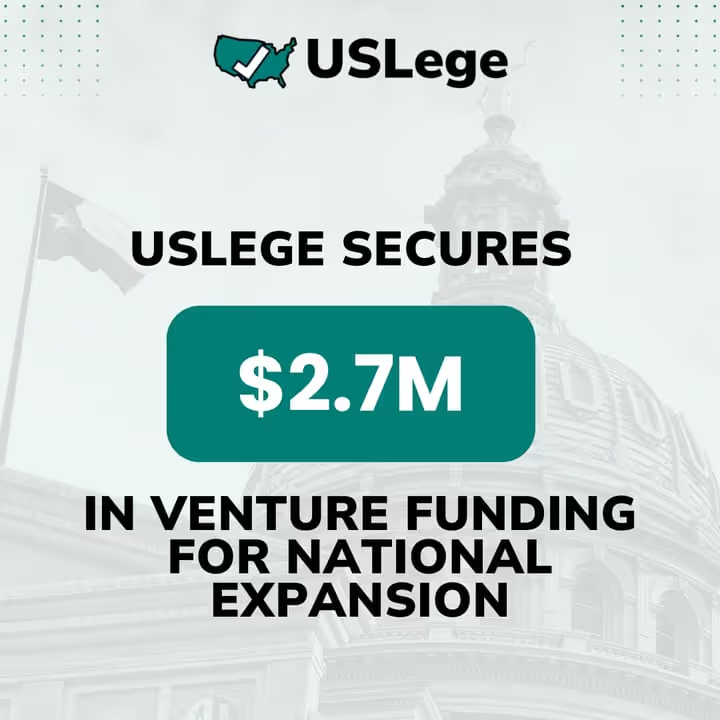
🤝 USLege Secures Venture Capital Funding to Accelerate Nationwide Expansion
We hope you enjoyed today’s read!
Stay connected with TXLege News on X and LinkedIn!
🤝 Texas Venture Forum & Gala May 28–29

USLege is headed to the Texas Venture Forum & Gala May 28–29, sponsoring, speaking, and podcasting live from the floor. Join us for the conference and gala at the intersection of tech and government.
🎙️We Have a Podcast! 🎙️
Bills and Business is your go-to podcast for conversations related to Texas legislation and business. Hosted by Laura Carr, Co-Founder of USLege—an AI-driven legislative tracking software—we bring you in-depth analysis on economic trends, impactful legislation, and key developments shaping Texas business.
Subscribe on Youtube and Spotify for weekly episodes!

- 01 First














Subscribe to our Newsletter

Read more news

How to Choose the Best Federal Legislative Tracking Software for Your Organization
Every year, thousands of bills move through Congress, and without the right tracking system, teams miss critical information that affects compliance, strategy, and advocacy.
Manual tracking creates gaps.
Teams rely on scattered data, delayed alerts, and inconsistent updates, which makes it harder to stay ahead of policy developments.
Modern legislative tracking tools solve this by centralizing legislative and regulatory data, automating bill tracking, and delivering real-time alerts.
They allow organizations to monitor federal legislation, understand the legislative process, and act quickly when changes occur.
In this guide, you’ll learn how to evaluate legislative monitoring platforms, what features matter most, and how policy management solutions help government affairs teams work smarter.
You will also see how to compare tools, avoid mistakes, and choose a system that fits your organization.
After reviewing your current workflow, you can explore a centralized system like federal legislative tracking software
to improve how your team tracks legislation and responds to policy changes.
What Is Federal Legislative Tracking Software?
Federal legislative tracking software is a system that helps organizations track bills, monitor committee hearings, and follow the full legislative process in one place.
It replaces manual spreadsheets with automated tracking, giving users access to accurate and updated data.
Core Functionality Explained
A strong legislative tracking tool provides:
- Bill tracking across Congress and committees.
- Real-time alerts when bills move or change.
- Search tools to filter legislation by keywords or policy areas.
- Centralized legislative and regulatory data.
Instead of checking multiple sources, users can track bills with just a few clicks.
These systems also:
- Automate legislative tracking across every legislative session.
- Provide bill summaries to quickly understand relevance.
- Deliver alerts when committee hearings or votes are scheduled.
- Help users stay informed about pending legislation and regulatory changes.
Congress introduces thousands of bills each year.
Without automation, tracking becomes inefficient and error-prone.
Why Organizations Need Legislative Monitoring Platforms
Organizations face constant pressure to monitor federal legislation and regulatory developments.
Missing a policy update can impact compliance, operations, and long-term planning.
Key Use Cases Across Industries
Legislative monitoring platforms support different teams across an organization:
- Government affairs teams track policy developments and engage with legislators.
- Public affairs professionals monitor regulatory tracking and advocacy efforts.
- Legal teams follow regulations and compliance requirements.
- Corporations track bills that impact stakeholders and clients.
These tools help organizations:
- Stay ahead of policy changes and regulatory developments.
- Improve response time with real-time alerts.
- Support advocacy and government relations strategies.
- Provide actionable insights for informed decisions.
For example, a public policy manager can monitor policy areas and receive alerts when bills move through committee assignments.
This allows the team to act quickly and ensure their voice is heard during advocacy efforts.
Essential Features to Look For in Policy Management Solutions
Choosing the right legislative tracking tool depends on features that align with your organization and workflow tools.
Real-Time Alerts and Notifications
Real-time alerts are critical for staying informed.
Look for:
- Alerts for bill movements, amendments, and executive orders.
- Email alerts and dashboard notifications.
- Alerts tailored to specific policy areas.
These alerts ensure your team never misses the latest developments.
Advanced Search and Filtering
Search functionality determines how quickly you find relevant results.
Key features include:
- Keyword-based search across legislative and regulatory data.
- Filters by committee, sponsor, and legislative session.
- Ability to track bills across multiple policy areas.
Strong search tools help teams quickly understand what matters.
Data Visualization and Reporting
Advanced reporting turns raw data into useful analysis.
Look for:
- Legislative dashboards that show trends.
- Custom reports for stakeholders and clients.
- Advanced reporting features for deeper analysis.
These features help organizations make informed decisions based on real data.
AI and Predictive Analytics
AI-powered tools are changing how legislative tracking works.
Capabilities include:
- AI-powered insights that summarize bills.
- Predictive analysis of policy changes.
- Detection of trends across legislation.
These tools help policy professionals quickly understand large volumes of data.
Integration Capabilities
Integration improves team collaboration and workflow.
Look for systems that:
- Connect with CRM and internal workflow tools.
- Allow teams to assign tasks and share notes.
- Support team collaboration across departments.
Integration ensures support teams can work together efficiently.
How to Evaluate Federal Legislative Tracking Software
Selecting the right legislative tracking tool requires a clear evaluation process.
Define Your Organization’s Needs
Start by understanding your organization:
- Size of your team.
- Type of legislative and regulatory tracking required.
- Level of engagement in government affairs.
This helps narrow down options.
Compare Features vs Cost
Pricing varies depending on coverage and features.
- Basic tools may cost around $1,000.
- Advanced systems can exceed $5,000.
Focus on ROI rather than price alone.
Assess Data Accuracy and Coverage
Accurate data is essential.
Check:
- Coverage of federal legislation and regulatory data.
- Frequency of updates from Congress.
- Quality of bill summaries and analysis.
to understand how legislative information is structured.
User Experience and Support
User experience affects adoption.
Evaluate:
- Ease of use.
- Onboarding and support.
- Ability for teams to collaborate.
A system should help your team work smarter, not harder.
Common Mistakes to Avoid When Choosing Legislative Tracking Systems
Many organizations choose tools without fully evaluating their needs.
Choosing Based on Price Alone
Low-cost tools may lack comprehensive coverage and advanced reporting.
Ignoring Integration Needs
Without integration, workflow tools become disconnected.
Overlooking User Adoption
Complex systems reduce productivity and team collaboration.
Not Testing the Platform
Always request demos or trials.
Testing ensures the tool fits your organization and supports your team.
Key Benefits of Using Federal Legislative Tracking Software
Organizations that adopt legislative tracking tools gain a clear advantage.
Improved Decision-Making
Access to real-time data leads to better analysis and informed decisions.
Time Efficiency
Automation helps teams save time by reducing manual research.
Enhanced Compliance
Tracking regulations and policy changes reduces compliance risks.
Strategic Advantage
Organizations can stay ahead of policy developments and act early.
Benefits include:
- Faster response to legislation.
- Better communication with stakeholders.
- Stronger advocacy and government relations strategies.
Future Trends in Legislative Monitoring Platforms
Legislative tracking continues to evolve with new technology.
AI and Machine Learning Integration
AI-powered systems provide predictive insights and deeper analysis.
Increased Automation
Automation reduces manual tracking and improves efficiency.
Data-Driven Policy Insights
Advanced analytics provide actionable insights into policy changes.
Organizations are shifting toward intelligent platforms that combine data, AI-powered tools, and automation.
How to Implement Legislative Tracking Software Successfully
Implementation determines long-term success.
Onboarding and Training
Train your team to use the system effectively.
Define Monitoring Criteria
Set alerts, keywords, and policy areas to track bills.
Integrate with Existing Systems
Ensure smooth workflow integration and team collaboration.
Proper setup helps organizations maximize value and stay informed.

#46 - The American Innovators Network with Megan Mauro
Welcome to Episode #46 of Bills & Business. In this episode, Laura Davis, Co-Founder of USLege, sits down with Megan Mauro, President and CEO of the Texas Association of Business and Texas Chapter President of the American Innovators Network.
Megan brings a unique dual perspective to the conversation, representing both large established companies and the startups and entrepreneurs that make up little tech. Together, Laura and Megan unpack one of the most important distinctions in tech policy today: the difference between regulating technology and regulating behavior. Megan makes the case that innovators should not be punished for unintended consequences, and that the most effective policy solutions come when industry and lawmakers work together early, with solutions in hand, not just complaints.
The conversation also covers the explosive growth of data centers and traditional manufacturing jobs tied to the tech sector, the real story behind AI and workforce creation, and why founders and operators in heavily regulated industries need a seat at the policy table now more than ever. Megan's closing message says it all: be at the table.
Don't forget to subscribe to Bills & Business on Apple Podcasts, Spotify, and YouTube for more deep dives into policy and business news.
📲 Follow Laura Davis
🐦 Twitter: @Laura_USLege https://x.com/Laura_USLege
💼 LinkedIn: https://www.linkedin.com/in/laurauslege/
📸 Instagram: https://www.instagram.com/thereallauracarr/
🛍️ ShopMy: https://shopmy.us/shop/lauraluise?Section_title=latest-finds&tab=collections
✍️ Substack: https://lauraluise.substack.com/
🔗 Links: https://lauraluise.carrd.co/
📲 Follow USLege
✨ Instagram: https://www.instagram.com/uslege.ai/
📘 Facebook: https://www.facebook.com/USLegeai
🐦 Twitter: @USLege_ai https://x.com/USLege_ai
💼 LinkedIn: https://www.linkedin.com/company/uslege-ai/
🎧 Subscribe to Bills & Business
🌐 Website: https://www.uslege.ai/
▶️ YouTube: https://www.youtube.com/@BillsandBusiness
🎵 Spotify: https://open.spotify.com/show/22ZWg9VVb2AEGqyV14osNi?si=effe3795f8414171
🍎 Apple Podcasts: https://podcasts.apple.com/ph/podcast/bills-and-business-by-uslege/id1781059329
🎥 TikTok: https://www.tiktok.com/@uslege
📲 Follow Megan Mauro
🐦 Twitter: @MeganMauroTX https://x.com/MeganMauroTX
💼 LinkedIn: https://www.linkedin.com/in/megan-mauro-14863326/
🎬 Produced by USLege
📞 Want to see USLege in action? Schedule a demo today! https://www.uslege.ai/demo
The Future of Policy Research: How AI Legislative Tracking Software Simplifies Bill Analysis
In the United States alone, state legislatures introduce tens of thousands of bills each year, while Congress debates hundreds of acts that directly affect sectors like health, education, and artificial intelligence.
Traditional manual methods—scanning portals, tracking spreadsheets, or relying on emailed alerts—often lead to missed updates, wasted time, and fragmented communication between teams. Modern AI technologies and generative AI tools are changing that dynamic. By integrating artificial intelligence with structured legislative data, today’s platforms reduce the time spent on routine searches, generate accurate summaries, and deliver instant alerts when new legislation is proposed or enacted.
This article explores how AI legislative tracking software simplifies bill analysis and why it matters for organizations engaged in government relations. You’ll learn how artificial intelligence, machine learning, and AI-powered analytics help teams stay ahead of emerging policies, evaluate enacted legislation across multiple states, and make more informed strategic decisions. This software serves as a valuable resource for policy teams, providing up-to-date information and guidance on navigating complex legislative environments.
For more details on how this technology transforms policy analysis, visit AI legislative tracking software.
What Is AI Legislative Tracking Software?
AI legislative tracking software is a digital framework built to monitor, analyze, and categorize legislation across jurisdictions. It uses artificial intelligence and machine learning to automate the once-manual process of reading lengthy bill text, identifying relevant topics, and alerting teams about updates that matter.
At its core, the technology performs a sequence of key steps:
- Data collection: The platform aggregates data from Congress, state legislatures, and local jurisdictions. Each bill, amendment, or act is indexed for quick access. Some platforms have created legislative deadlines calendars to help users track important dates.
- Natural-language processing: Advanced AI technologies interpret legal language, detect bill subjects, and link related regulations.
- Classification & scoring: Generative AI models classify proposed legislation based on environmental, fiscal, and technological topics and assign relevance scores.
- Alerting mechanisms: Real-time notifications inform stakeholders when hearings happen, votes occur, or enacted legislation modifies existing law.
Unlike traditional manual trackers that rely on keyword searches, AI systems analyze entire bill structures, track progress through committees, and flag potential impact areas. This approach creates smarter, faster insights for any organization that must stay informed.
AI technology also enables predictive analytics, such as estimating the likelihood of a bill passing, identifying influential legislators, and highlighting amendments that affect a specific policy area. The result is less time wasted on routine monitoring and more focus on strategy, advocacy, and justice-related outcomes.
Across the country, policy teams use these tools to analyze regulations, create summaries for internal reports, and coordinate responses with stakeholders in government offices. For example, a compliance team might use a tracker to flag new legislation affecting AI regulation or data privacy requirements in other states.
Why Benefits Matter: From Hours to Minutes
The biggest benefit of artificial intelligence in government affairs is efficiency. By replacing manual searches with automated analysis, organizations spend less time gathering information and more time refining their policy strategy. With this extra capacity, organizations can develop more effective strategies for advocacy and compliance.
Key benefits include:
- Speed and automation: AI-powered trackers reduce time spent reviewing hundreds of bills by instantly flagging those that match an organization’s focus.
- Relevance filtering: Generative AI tools can rank bills by risk level or strategic importance, ensuring nothing important gets missed.
- Predictive insight: Machine learning algorithms use historical data to predict which acts are likely to advance through legislators.
- Comprehensive coverage: Many AI systems use advanced AI technologies to monitor Congress and all 50 state legislatures, helping teams stay ahead across multiple states.
- Improved decision-making: Centralized dashboards give a clear view of how bills progress, letting government relations staff act quickly.
The outcome is measurable. Organizations report significant reductions in manual labor and better coordination between departments. By allowing teams to stay ahead of policy developments, AI innovation turns reactive monitoring into proactive governance.
Artificial intelligence does not replace expert analysis—it enhances it. Human analysts still interpret the political context and advise on strategy, but AI systems handle the repetitive data tasks that once consumed entire days.
Core Features & Capabilities to Look For
When evaluating policy tracking tools, understanding the core features that differentiate effective platforms is critical. Each feature supports a different stage of the research process—from data collection to report creation and stakeholder communication.
These platforms serve as a valuable resource for policy research and coordination, providing up-to-date information and guidance for AI governance stakeholders.
Many of these features are powered by advanced AI technologies, supporting efficient data analysis, compliance tracking, and collaboration.
1. Real-Time Legislative Updates
AI-powered systems pull data directly from legislative APIs the moment new bills are filed or acts are amended. Users can access immediate notifications when committee votes happen or when enacted legislation changes existing statutes.
2. Natural-Language Processing and Summarization
Through NLP, artificial intelligence summarizes bill text and extracts key provisions in plain language. This tool helps analysts explain complex topics clearly and reduce duplicate efforts across an organization.
3. Machine Learning Classification
Advanced models analyze bill data to identify patterns and trends. They learn from past legislation to categorize new bills accurately and suggest how they might affect specific industries or services.
4. Predictive Analytics and Trend Visualization
AI technology creates interactive dashboards that visualize how acts move through Congress and state legislatures. Teams can track progress and prepare for risks or opportunities based on historical patterns.
5. Custom Alerts and Stakeholder Management
Every organization has unique priorities. AI systems allow users to set custom alerts, tag stakeholders, and automate report distribution. A government relations team can receive updates only on bills relevant to its policy plan.
6. Integration and APIs
Modern trackers integrate with existing CRMs or data-visualization tools. This ensures that new legislation appears automatically in internal dashboards and that policy analysts spend less time copying data between systems.
7. Reporting & Collaboration
Robust report functions allow users to create summaries for executives or boards. Reports can highlight proposed bills, identify risks, and show outcomes of specific acts. Teams within government offices use these reports to coordinate responses and track policy development. These reports serve as a valuable resource for decision-making and communication among stakeholders.
The National Institute of Standards has outlined guidelines that emphasize how artificial intelligence should support transparency in AI policy research. By aligning tools with those principles, organizations ensure their data handling meets fair and ethical standards for justice and accountability.
Generative AI continues to expand these capabilities. New generative AI tools can draft policy briefs, create summaries of enacted legislation, and even analyze public comments on proposed regulations. Such AI applications save resources, improve accuracy, and keep stakeholders ahead of emerging issues.
Use Cases: Who Benefits from AI Legislative Tracking
Artificial intelligence has expanded how government affairs teams manage policy research across multiple states and Congress. Each organization—from a local advocacy office to a national institute studying AI policy—now uses generative AI tools to process legislation and enacted legislation efficiently.
Key groups that benefit include:
- Corporate Government Affairs Teams: They monitor proposed acts and regulations that may affect company operations, enabling the team to stay ahead of compliance risks.
- Trade Associations: Associations use AI systems to create summaries of bills across jurisdictions, providing members with clear reports about what matters most.
- Law Firms & Consultancies: Firms apply AI-powered analytics to explain complex legislation for clients and reduce the time spent on manual tracking.
- Advocacy Groups & Nonprofits: AI innovation allows staff to analyze proposed laws related to justice or environmental outcomes and coordinate public policy work accordingly.
- Research Institutes & Think Tanks: These organizations use machine learning to analyze bill trends, evaluate AI regulation frameworks, and issue data-driven policy reports.
Across the country, AI-powered trackers give stakeholders in government relations access to accurate updates, reducing the chance they miss important developments. Generative AI further enhances these tools by drafting briefs and highlighting how new legislation could affect an organization’s priorities. This tool helps policy teams spend less time on data entry and more on strategy and communication.
Challenges and Considerations in Implementation
Despite clear benefits, adopting AI technology in government offices and private policy organizations comes with significant challenges, such as ensuring compliance, managing risks, and maintaining data integrity throughout the legislative tracking process.
Common implementation challenges include:
- Data Quality and Consistency — Legislation from different jurisdictions often uses inconsistent formats. AI systems must be trained to analyze diverse data sources without losing accuracy.
- Alert Fatigue — If filters are poorly set, teams receive too many irrelevant notifications, increasing the risk they miss the bills that truly matter.
- Training and Onboarding — Each team must learn how to define keywords, set priorities, and create reports that match organizational needs.
- Integration with Existing Tools — Linking trackers to CRMs, analytics dashboards, or other AI technologies requires planning and technical resources.
- Cost and Scalability — Some AI applications charge based on the volume of tracked legislation or the number of users, so budgeting must be part of the plan.
- Change Management — Introducing AI in a traditional government context can trigger concerns about fair use, privacy, and accountability.
When organizations plan early and train properly, these challenges become manageable. A well-structured AI task force inside each organization can set policies for data access, governance, and ethical boundaries in line with the National Institute guidance on AI governance software.
How to Evaluate and Select the Right Solution
Selecting the right AI-powered tracker is a strategic decision that depends on scope, coverage, and support. Use the following steps to create an effective evaluation plan and stay ahead of policy developments across jurisdictions. Developing strategies for selecting the best-fit solution is essential to align with your organization's goals and regulatory requirements.
- Define Scope and Priorities: Identify which topics, acts, and regulations affect your organization. Include AI policy, data governance, and sector-specific concerns.
- Evaluate Coverage: Confirm that the tool covers Congress, state legislatures, and other states where you operate.
- Assess Artificial Intelligence Capabilities: Check for natural-language summarization, predictive analytics, and integration with generative AI tools.
- User Experience and Access: Ensure teams can easily search, filter, and analyze bills without technical barriers.
- Integration and APIs: AI systems should connect seamlessly to existing government affairs dashboards and issue-management tools.
- Security and Compliance: Verify how data is stored and whether the provider adheres to AI regulation standards.
- Reporting and Analytics: Confirm that the system can create custom reports summarizing proposed and enacted legislation for different stakeholders.
- Pilot Testing: Before full deployment, track a sample set of bills and evaluate how the AI analyzes content and alerts users. Pilot programs serve as a valuable resource for evaluating software effectiveness and ensuring the solution meets your organization's needs.
These steps help organizations make fair comparisons and measure real benefits before long-term commitments. They also reduce the risks associated with AI adoption by ensuring each tool helps users achieve clear, ethical outcomes.
Broader Implications for AI Governance and Public Policy
Artificial intelligence is reshaping how governments draft and enforce legislation. AI governance software is now used to analyze bills, identify AI-related concerns, and support regulatory development. Many countries and organizations are developing comprehensive AI governance strategies, including regulatory, ethical, and operational strategies, to foster innovation while managing risks. An AI task force within a government agency may review proposed AI regulations to ensure fair and transparent implementation.
Generative AI has introduced new risks and new opportunities. The 30 percent rule in AI—a guideline used by some policy bodies to limit automated decision-making in critical contexts—illustrates how officials balance innovation with justice and ethical outcomes. When AI systems analyze public policy, they must respect privacy, reduce bias, and create fair access to government services.
The National Institute for Technology Standards has called for AI technologies that support the responsible development of AI innovation while keeping humans in control of final decisions. That balance ensures that artificial intelligence remains a tool to assist, not replace, expert policy judgment.
How AI Supports Legal and Regulatory Teams
Lawyers and compliance professionals often ask, “What is the best AI software for lawyers?” The answer depends on focus areas, but most government affairs offices prefer AI systems that combine bill analysis with risk reporting and automatic alerts. Such tools track enacted legislation, monitor proposed acts, and summarize potential impact in a single dashboard. These platforms serve as a valuable resource for legal and compliance teams, providing up-to-date information and guidance on AI regulations.
By using AI-powered search capabilities and machine learning technologies, legal teams spend less time reading full bill texts and more time advising on strategy. The tools can create summaries, highlight regulations that affect specific industries, and generate reports that support policy briefings. AI technology also helps teams analyze cross-state patterns, so they stay informed about how different jurisdictions approach similar issues.
For example, when one state passes an AI regulation act, other states often follow with similar proposed legislation. AI trackers make it easy to search these connections and report on how quickly policy ideas spread through the country. This continuous analysis helps government relations staff anticipate changes before they happen.
Staying Ahead in the Age of AI
As AI innovation accelerates, organizations that stay ahead gain a strategic advantage. By deploying AI-powered trackers, policy teams can monitor enacted legislation and proposed acts across jurisdictions without expanding headcount. This lets them stay informed and focus on analysis rather than data entry.
The best strategy is to treat AI as a partner in policy development. Use AI systems to search for patterns, analyze risks, and generate summaries, but keep humans in control of interpretation. Developing strategies to maximize the benefits of AI legislative tracking software is essential for organizations aiming to enhance efficiency and maintain oversight. That balance ensures that decisions remain grounded in fair and ethical judgment.

Texas Political Spotlight
Welcome back, friends
Texas hemp businesses have filed suit to block new state regulations they say effectively ban smokeable hemp products and impose licensing fee increases so steep they could force many businesses to close. Yesterday, the Texas House State Affairs Committee heard testimony on the explosive growth of data centers in the state, with interconnection requests on the power grid now exceeding 400,000 megawatts and raising questions about cost, reliability, and water usage. Lastly, nineteen Texas summer camps are challenging a new state mandate requiring them to install fiber optic internet infrastructure, citing costs as high as $1.2 million and arguing the requirement is unworkable for rural properties and does nothing to improve camper safety.
Before you dive in…

USLege will be hosting our first ever Best in Government Affairs Awards Ceremony on April 23rd at Speakeasy in Downtown Austin.
Winners and guests will be treated to evening of celebration for the accomplishments in the 89th Texas Legislative Session.
You can expect music, networking, food & drinks and formal award acceptance.
This is going to be a fun party! We hope to see you there.
»» RSVP HERE: Best in Government Affairs Awards Ceremony hosted by USLege

»» Watch Representative Ken King’s Intro Here ««
We hope you enjoyed today’s read!
Stay connected with TXLege News on X and LinkedIn!
Texas Political Spotlight
Welcome back, friends
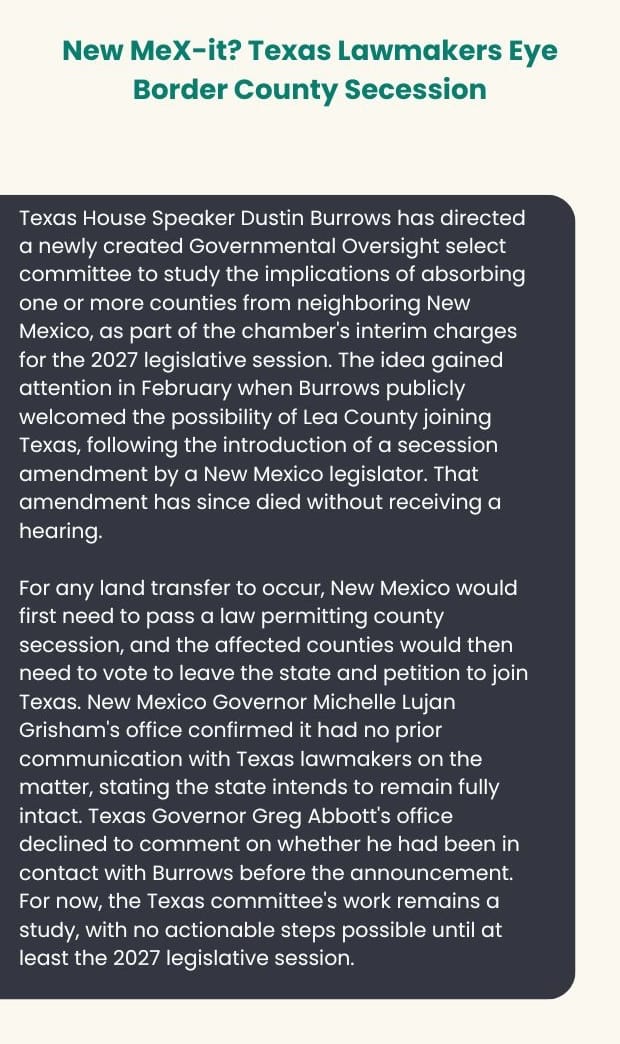
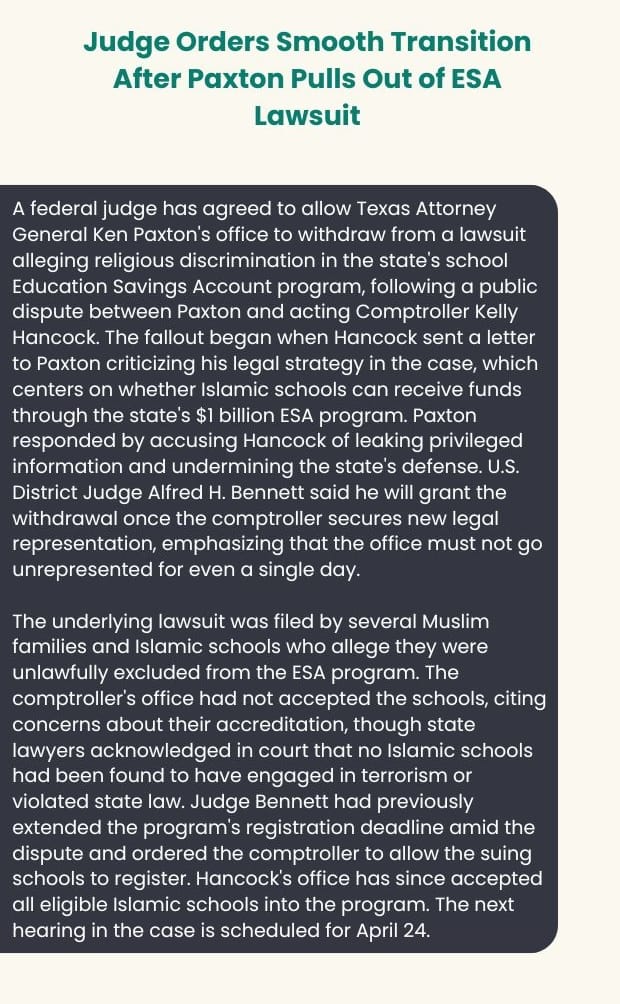
A federal trial is underway in Texas over whether the state's prison system has done enough to protect inmates from extreme heat, with a price tag of $1.5 billion standing at the center of the debate. Texas House Speaker Dustin Burrows has tasked a new legislative committee with studying whether Texas could absorb one or more counties from New Mexico, a long-shot proposal that has already drawn a sharp response from the neighboring state's governor. A public feud between Texas Attorney General Ken Paxton and acting Comptroller Kelly Hancock has spilled into federal court, where a judge is overseeing the fallout in a lawsuit alleging religious discrimination in the state's $1 billion ESA Program.
We hope you enjoyed today’s read!
Stay connected with TXLege News on X and LinkedIn!
Texas Political Spotlight
Welcome back, friends
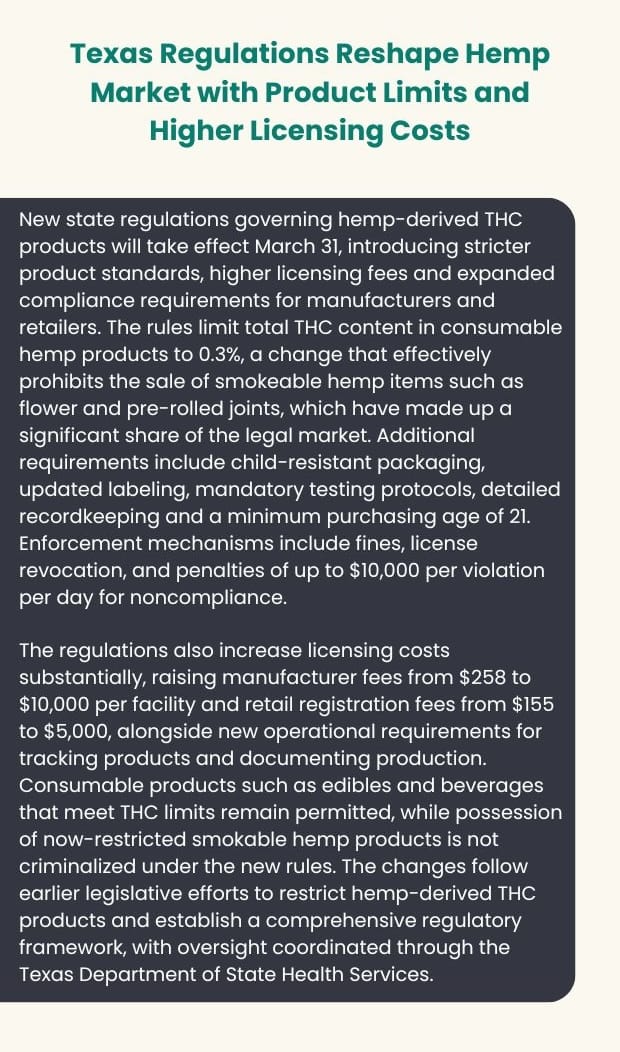
New Texas rules on hemp-derived THC products take effect March 31, reshaping what can be sold, who can sell it and how the industry operates, with major implications for businesses, consumers and enforcement across the state. Lt. Gov Dan Patrick has unveiled the Texas Senate committee lineup. At the same time, state education leaders are moving to revise curriculum guidance tied to Cesar Chavez amid emerging allegations, prompting immediate changes in classrooms and raising broader questions about how schools respond when historical narratives shift.
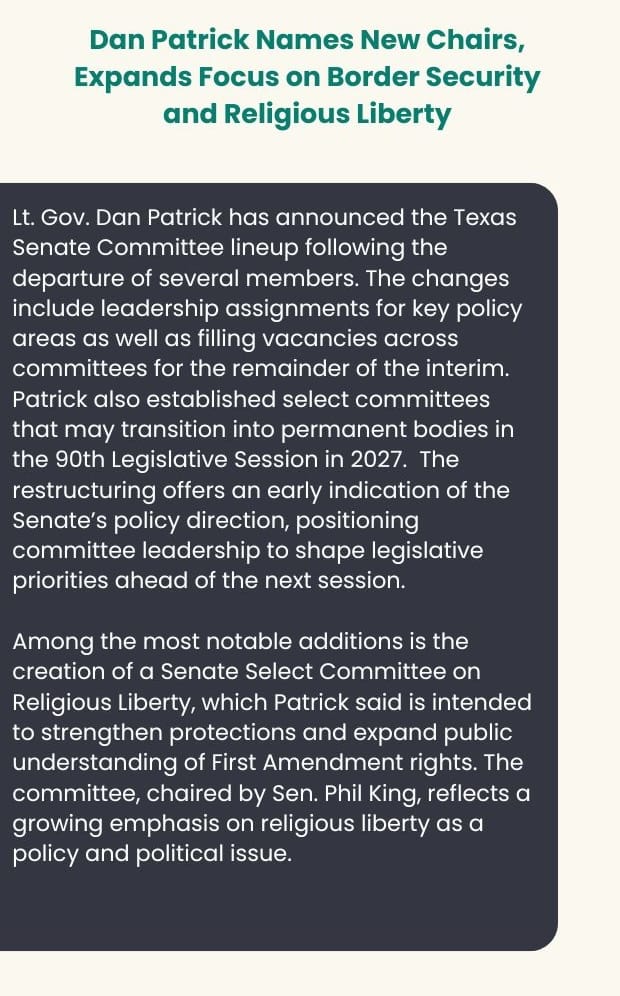
»»» View official press release from Lt. Gov. Dan Patrick Here «««
We hope you enjoyed today’s read!
Stay connected with TXLege News on X and LinkedIn!


