

Welcome back, friends
The House has passed a massive $337 billion budget focused on education, border security, and tax cuts. Meanwhile, former U.S. Attorney John Bash is making headlines as the first candidate to enter the race for attorney general, hoping to replace Ken Paxton as he eyes a Senate run. Lastly, Lt. Gov. Dan Patrick is officially seeking a historic fourth term, backed by Donald Trump and poised to solidify his legacy as one of the most powerful figures in state government.
Today’s Insights:
- Texas House Passes Their Version of SB 1, Focused on Education, Border Security, and Tax Cuts
- Bash Becomes First to Declare Candidacy for Texas Attorney General in 2026
- Lt. Gov. Patrick Calls Announces Bid For Re-election
Texas House Passes Their Version of SB 1, Focused on Education, Border Security, and Tax Cuts
The Texas House passed SB 1, a $337 billion two-year state budget following over 13 hours of debate that saw nearly 400 proposed amendments, most of which were rejected or set aside. The budget includes significant funding increases for public education, border security, and property tax relief. It allocates $154 billion in general revenue, the state's main pool of taxpayer dollars, with most going toward education, health services, and public safety. Notably, it leaves about $40 billion in general revenue unspent, well below the state's available funds unless both chambers agree to override a constitutional spending cap, which remains unlikely. The proposal passed with bipartisan support but also faced dissent from both sides: conservatives wanted more for tax relief, while some Democrats objected to school voucher funding.
Several high-profile amendments generated debate but ultimately failed, including attempts to defund the Texas Lottery, expand Medicaid, and redirect border security funds to other services like childcare or teacher salaries. A few amendments did pass, such as one that moves $70 million from Medicaid to the state's anti-abortion program, and another directing a study of clergy accused of child abuse. The budget maintains $1 billion for a proposed school voucher program and directs $51 billion toward property tax cuts. Lawmakers also approved a $12 billion supplemental budget for infrastructure, wildfire response, and university funding. Final negotiations will now move to a conference committee, where House and Senate members will reconcile the differences between the two chambers' versions of SB 1.
Bash Becomes First to Declare Candidacy for Texas Attorney General in 2026
Former U.S. Attorney John Bash has officially launched his campaign for Texas attorney general, becoming the first to enter the race to replace incumbent Ken Paxton, who is running for U.S. Senate. Bash previously served as the top federal prosecutor for the Western District of Texas and was a special assistant to President Donald Trump. Since leaving government service in 2020, he has taken on high-profile legal work in the private sector, including representing Elon Musk in a defamation case. His wife, Zina Bash, served as a senior counsel to Paxton until 2021.
In his campaign announcement, Bash positioned himself as a strong conservative candidate, pledging to protect public safety, defend constitutional rights, and promote innovation and growth in Texas. He highlighted his prosecutorial record, including leading the cases against the 2018 Austin bomber and former state Sen. Carlos Uresti, who was convicted in a corruption scheme. Bash’s entry into the race follows Paxton’s recent announcement that he will challenge U.S. Sen. John Cornyn in the upcoming election. While Paxton is not required to resign his post to run for Senate, state law prevents him from appearing on the ballot for two positions.
Lt. Gov. Patrick Calls Announces Bid For Re-election
Lt. Gov. Dan Patrick announced he will seek a fourth term in office, emphasizing his continued focus on the current legislative session and noting that a formal campaign launch will follow. Patrick, who first took office in 2015 after unseating incumbent David Dewhurst, has been a prominent figure in advancing a conservative legislative agenda, including policies on border enforcement, school choice, and tax reductions. He received an early endorsement from former President Donald Trump, who praised his longstanding support and leadership in Texas. A former state senator and radio host, Patrick has become one of the most influential figures in Texas politics, overseeing a state Senate that analysts say has become increasingly aligned with his priorities. Polling from the Texas Political Project shows that a majority of conservative voters view Patrick’s performance positively, with an estimated 65% of Republicans polled as somewhat approving or strongly approving. Political experts suggest Patrick is unlikely to face serious opposition, and if re-elected, he will become the second-longest serving lieutenant governor in Texas history.
We hope you enjoyed today’s read!
🎙️We Have a Podcast! 🎙️
Bills and Business is your go-to podcast for conversations related to Texas legislation and business. Hosted by Laura Carr, Co-Founder of USLege—an AI-driven legislative tracking software—we bring you in-depth analysis on economic trends, impactful legislation, and key developments shaping Texas business.
Subscribe on Youtube and Spotify for weekly episodes!

- 01 First



















Subscribe to our Newsletter

Read more news

#46 - The American Innovators Network with Megan Mauro
Welcome to Episode #46 of Bills & Business. In this episode, Laura Davis, Co-Founder of USLege, sits down with Megan Mauro, President and CEO of the Texas Association of Business and Texas Chapter President of the American Innovators Network.
Megan brings a unique dual perspective to the conversation, representing both large established companies and the startups and entrepreneurs that make up little tech. Together, Laura and Megan unpack one of the most important distinctions in tech policy today: the difference between regulating technology and regulating behavior. Megan makes the case that innovators should not be punished for unintended consequences, and that the most effective policy solutions come when industry and lawmakers work together early, with solutions in hand, not just complaints.
The conversation also covers the explosive growth of data centers and traditional manufacturing jobs tied to the tech sector, the real story behind AI and workforce creation, and why founders and operators in heavily regulated industries need a seat at the policy table now more than ever. Megan's closing message says it all: be at the table.
Don't forget to subscribe to Bills & Business on Apple Podcasts, Spotify, and YouTube for more deep dives into policy and business news.
📲 Follow Laura Davis
🐦 Twitter: @Laura_USLege https://x.com/Laura_USLege
💼 LinkedIn: https://www.linkedin.com/in/laurauslege/
📸 Instagram: https://www.instagram.com/thereallauracarr/
🛍️ ShopMy: https://shopmy.us/shop/lauraluise?Section_title=latest-finds&tab=collections
✍️ Substack: https://lauraluise.substack.com/
🔗 Links: https://lauraluise.carrd.co/
📲 Follow USLege
✨ Instagram: https://www.instagram.com/uslege.ai/
📘 Facebook: https://www.facebook.com/USLegeai
🐦 Twitter: @USLege_ai https://x.com/USLege_ai
💼 LinkedIn: https://www.linkedin.com/company/uslege-ai/
🎧 Subscribe to Bills & Business
🌐 Website: https://www.uslege.ai/
▶️ YouTube: https://www.youtube.com/@BillsandBusiness
🎵 Spotify: https://open.spotify.com/show/22ZWg9VVb2AEGqyV14osNi?si=effe3795f8414171
🍎 Apple Podcasts: https://podcasts.apple.com/ph/podcast/bills-and-business-by-uslege/id1781059329
🎥 TikTok: https://www.tiktok.com/@uslege
📲 Follow Megan Mauro
🐦 Twitter: @MeganMauroTX https://x.com/MeganMauroTX
💼 LinkedIn: https://www.linkedin.com/in/megan-mauro-14863326/
🎬 Produced by USLege
📞 Want to see USLege in action? Schedule a demo today! https://www.uslege.ai/demo

The Future of Policy Research: How AI Legislative Tracking Software Simplifies Bill Analysis
In the United States alone, state legislatures introduce tens of thousands of bills each year, while Congress debates hundreds of acts that directly affect sectors like health, education, and artificial intelligence.
Traditional manual methods—scanning portals, tracking spreadsheets, or relying on emailed alerts—often lead to missed updates, wasted time, and fragmented communication between teams. Modern AI technologies and generative AI tools are changing that dynamic. By integrating artificial intelligence with structured legislative data, today’s platforms reduce the time spent on routine searches, generate accurate summaries, and deliver instant alerts when new legislation is proposed or enacted.
This article explores how AI legislative tracking software simplifies bill analysis and why it matters for organizations engaged in government relations. You’ll learn how artificial intelligence, machine learning, and AI-powered analytics help teams stay ahead of emerging policies, evaluate enacted legislation across multiple states, and make more informed strategic decisions. This software serves as a valuable resource for policy teams, providing up-to-date information and guidance on navigating complex legislative environments.
For more details on how this technology transforms policy analysis, visit AI legislative tracking software.
What Is AI Legislative Tracking Software?
AI legislative tracking software is a digital framework built to monitor, analyze, and categorize legislation across jurisdictions. It uses artificial intelligence and machine learning to automate the once-manual process of reading lengthy bill text, identifying relevant topics, and alerting teams about updates that matter.
At its core, the technology performs a sequence of key steps:
- Data collection: The platform aggregates data from Congress, state legislatures, and local jurisdictions. Each bill, amendment, or act is indexed for quick access. Some platforms have created legislative deadlines calendars to help users track important dates.
- Natural-language processing: Advanced AI technologies interpret legal language, detect bill subjects, and link related regulations.
- Classification & scoring: Generative AI models classify proposed legislation based on environmental, fiscal, and technological topics and assign relevance scores.
- Alerting mechanisms: Real-time notifications inform stakeholders when hearings happen, votes occur, or enacted legislation modifies existing law.
Unlike traditional manual trackers that rely on keyword searches, AI systems analyze entire bill structures, track progress through committees, and flag potential impact areas. This approach creates smarter, faster insights for any organization that must stay informed.
AI technology also enables predictive analytics, such as estimating the likelihood of a bill passing, identifying influential legislators, and highlighting amendments that affect a specific policy area. The result is less time wasted on routine monitoring and more focus on strategy, advocacy, and justice-related outcomes.
Across the country, policy teams use these tools to analyze regulations, create summaries for internal reports, and coordinate responses with stakeholders in government offices. For example, a compliance team might use a tracker to flag new legislation affecting AI regulation or data privacy requirements in other states.
Why Benefits Matter: From Hours to Minutes
The biggest benefit of artificial intelligence in government affairs is efficiency. By replacing manual searches with automated analysis, organizations spend less time gathering information and more time refining their policy strategy. With this extra capacity, organizations can develop more effective strategies for advocacy and compliance.
Key benefits include:
- Speed and automation: AI-powered trackers reduce time spent reviewing hundreds of bills by instantly flagging those that match an organization’s focus.
- Relevance filtering: Generative AI tools can rank bills by risk level or strategic importance, ensuring nothing important gets missed.
- Predictive insight: Machine learning algorithms use historical data to predict which acts are likely to advance through legislators.
- Comprehensive coverage: Many AI systems use advanced AI technologies to monitor Congress and all 50 state legislatures, helping teams stay ahead across multiple states.
- Improved decision-making: Centralized dashboards give a clear view of how bills progress, letting government relations staff act quickly.
The outcome is measurable. Organizations report significant reductions in manual labor and better coordination between departments. By allowing teams to stay ahead of policy developments, AI innovation turns reactive monitoring into proactive governance.
Artificial intelligence does not replace expert analysis—it enhances it. Human analysts still interpret the political context and advise on strategy, but AI systems handle the repetitive data tasks that once consumed entire days.
Core Features & Capabilities to Look For
When evaluating policy tracking tools, understanding the core features that differentiate effective platforms is critical. Each feature supports a different stage of the research process—from data collection to report creation and stakeholder communication.
These platforms serve as a valuable resource for policy research and coordination, providing up-to-date information and guidance for AI governance stakeholders.
Many of these features are powered by advanced AI technologies, supporting efficient data analysis, compliance tracking, and collaboration.
1. Real-Time Legislative Updates
AI-powered systems pull data directly from legislative APIs the moment new bills are filed or acts are amended. Users can access immediate notifications when committee votes happen or when enacted legislation changes existing statutes.
2. Natural-Language Processing and Summarization
Through NLP, artificial intelligence summarizes bill text and extracts key provisions in plain language. This tool helps analysts explain complex topics clearly and reduce duplicate efforts across an organization.
3. Machine Learning Classification
Advanced models analyze bill data to identify patterns and trends. They learn from past legislation to categorize new bills accurately and suggest how they might affect specific industries or services.
4. Predictive Analytics and Trend Visualization
AI technology creates interactive dashboards that visualize how acts move through Congress and state legislatures. Teams can track progress and prepare for risks or opportunities based on historical patterns.
5. Custom Alerts and Stakeholder Management
Every organization has unique priorities. AI systems allow users to set custom alerts, tag stakeholders, and automate report distribution. A government relations team can receive updates only on bills relevant to its policy plan.
6. Integration and APIs
Modern trackers integrate with existing CRMs or data-visualization tools. This ensures that new legislation appears automatically in internal dashboards and that policy analysts spend less time copying data between systems.
7. Reporting & Collaboration
Robust report functions allow users to create summaries for executives or boards. Reports can highlight proposed bills, identify risks, and show outcomes of specific acts. Teams within government offices use these reports to coordinate responses and track policy development. These reports serve as a valuable resource for decision-making and communication among stakeholders.
The National Institute of Standards has outlined guidelines that emphasize how artificial intelligence should support transparency in AI policy research. By aligning tools with those principles, organizations ensure their data handling meets fair and ethical standards for justice and accountability.
Generative AI continues to expand these capabilities. New generative AI tools can draft policy briefs, create summaries of enacted legislation, and even analyze public comments on proposed regulations. Such AI applications save resources, improve accuracy, and keep stakeholders ahead of emerging issues.
Use Cases: Who Benefits from AI Legislative Tracking
Artificial intelligence has expanded how government affairs teams manage policy research across multiple states and Congress. Each organization—from a local advocacy office to a national institute studying AI policy—now uses generative AI tools to process legislation and enacted legislation efficiently.
Key groups that benefit include:
- Corporate Government Affairs Teams: They monitor proposed acts and regulations that may affect company operations, enabling the team to stay ahead of compliance risks.
- Trade Associations: Associations use AI systems to create summaries of bills across jurisdictions, providing members with clear reports about what matters most.
- Law Firms & Consultancies: Firms apply AI-powered analytics to explain complex legislation for clients and reduce the time spent on manual tracking.
- Advocacy Groups & Nonprofits: AI innovation allows staff to analyze proposed laws related to justice or environmental outcomes and coordinate public policy work accordingly.
- Research Institutes & Think Tanks: These organizations use machine learning to analyze bill trends, evaluate AI regulation frameworks, and issue data-driven policy reports.
Across the country, AI-powered trackers give stakeholders in government relations access to accurate updates, reducing the chance they miss important developments. Generative AI further enhances these tools by drafting briefs and highlighting how new legislation could affect an organization’s priorities. This tool helps policy teams spend less time on data entry and more on strategy and communication.
Challenges and Considerations in Implementation
Despite clear benefits, adopting AI technology in government offices and private policy organizations comes with significant challenges, such as ensuring compliance, managing risks, and maintaining data integrity throughout the legislative tracking process.
Common implementation challenges include:
- Data Quality and Consistency — Legislation from different jurisdictions often uses inconsistent formats. AI systems must be trained to analyze diverse data sources without losing accuracy.
- Alert Fatigue — If filters are poorly set, teams receive too many irrelevant notifications, increasing the risk they miss the bills that truly matter.
- Training and Onboarding — Each team must learn how to define keywords, set priorities, and create reports that match organizational needs.
- Integration with Existing Tools — Linking trackers to CRMs, analytics dashboards, or other AI technologies requires planning and technical resources.
- Cost and Scalability — Some AI applications charge based on the volume of tracked legislation or the number of users, so budgeting must be part of the plan.
- Change Management — Introducing AI in a traditional government context can trigger concerns about fair use, privacy, and accountability.
When organizations plan early and train properly, these challenges become manageable. A well-structured AI task force inside each organization can set policies for data access, governance, and ethical boundaries in line with the National Institute guidance on AI governance software.
How to Evaluate and Select the Right Solution
Selecting the right AI-powered tracker is a strategic decision that depends on scope, coverage, and support. Use the following steps to create an effective evaluation plan and stay ahead of policy developments across jurisdictions. Developing strategies for selecting the best-fit solution is essential to align with your organization's goals and regulatory requirements.
- Define Scope and Priorities: Identify which topics, acts, and regulations affect your organization. Include AI policy, data governance, and sector-specific concerns.
- Evaluate Coverage: Confirm that the tool covers Congress, state legislatures, and other states where you operate.
- Assess Artificial Intelligence Capabilities: Check for natural-language summarization, predictive analytics, and integration with generative AI tools.
- User Experience and Access: Ensure teams can easily search, filter, and analyze bills without technical barriers.
- Integration and APIs: AI systems should connect seamlessly to existing government affairs dashboards and issue-management tools.
- Security and Compliance: Verify how data is stored and whether the provider adheres to AI regulation standards.
- Reporting and Analytics: Confirm that the system can create custom reports summarizing proposed and enacted legislation for different stakeholders.
- Pilot Testing: Before full deployment, track a sample set of bills and evaluate how the AI analyzes content and alerts users. Pilot programs serve as a valuable resource for evaluating software effectiveness and ensuring the solution meets your organization's needs.
These steps help organizations make fair comparisons and measure real benefits before long-term commitments. They also reduce the risks associated with AI adoption by ensuring each tool helps users achieve clear, ethical outcomes.
Broader Implications for AI Governance and Public Policy
Artificial intelligence is reshaping how governments draft and enforce legislation. AI governance software is now used to analyze bills, identify AI-related concerns, and support regulatory development. Many countries and organizations are developing comprehensive AI governance strategies, including regulatory, ethical, and operational strategies, to foster innovation while managing risks. An AI task force within a government agency may review proposed AI regulations to ensure fair and transparent implementation.
Generative AI has introduced new risks and new opportunities. The 30 percent rule in AI—a guideline used by some policy bodies to limit automated decision-making in critical contexts—illustrates how officials balance innovation with justice and ethical outcomes. When AI systems analyze public policy, they must respect privacy, reduce bias, and create fair access to government services.
The National Institute for Technology Standards has called for AI technologies that support the responsible development of AI innovation while keeping humans in control of final decisions. That balance ensures that artificial intelligence remains a tool to assist, not replace, expert policy judgment.
How AI Supports Legal and Regulatory Teams
Lawyers and compliance professionals often ask, “What is the best AI software for lawyers?” The answer depends on focus areas, but most government affairs offices prefer AI systems that combine bill analysis with risk reporting and automatic alerts. Such tools track enacted legislation, monitor proposed acts, and summarize potential impact in a single dashboard. These platforms serve as a valuable resource for legal and compliance teams, providing up-to-date information and guidance on AI regulations.
By using AI-powered search capabilities and machine learning technologies, legal teams spend less time reading full bill texts and more time advising on strategy. The tools can create summaries, highlight regulations that affect specific industries, and generate reports that support policy briefings. AI technology also helps teams analyze cross-state patterns, so they stay informed about how different jurisdictions approach similar issues.
For example, when one state passes an AI regulation act, other states often follow with similar proposed legislation. AI trackers make it easy to search these connections and report on how quickly policy ideas spread through the country. This continuous analysis helps government relations staff anticipate changes before they happen.
Staying Ahead in the Age of AI
As AI innovation accelerates, organizations that stay ahead gain a strategic advantage. By deploying AI-powered trackers, policy teams can monitor enacted legislation and proposed acts across jurisdictions without expanding headcount. This lets them stay informed and focus on analysis rather than data entry.
The best strategy is to treat AI as a partner in policy development. Use AI systems to search for patterns, analyze risks, and generate summaries, but keep humans in control of interpretation. Developing strategies to maximize the benefits of AI legislative tracking software is essential for organizations aiming to enhance efficiency and maintain oversight. That balance ensures that decisions remain grounded in fair and ethical judgment.

From Policy to Practice: What AI in Government Actually Looks Like Right Now
On March 18th, USLege Co-Founder and CBO Laura Davis joined Texas Senate Majority Leader Tan Parker, Texas Department of Information Resources Executive Director Tony Sauerhoff, and Texas Public Policy Foundation Associate VP David Dunmoyer on stage at SXSW 2026 for a session called "From Policy to Practice: AI Implementation in Government."
When it ended, the audience rushed the stage and kept talking until SXSW staff had to clear the room.
Here's what they said.
1. The foundation has to come first.
Tony Sauerhoff runs technology for the entire state of Texas. His description of what AI implementation looks like inside government? "A lot less like a sudden revolution, and more like disciplined, methodical modernization."
State agencies run on everything from modern cloud infrastructure to COBOL systems that predate the internet. Procurement cycles run on two-year budget calendars. AI model generations don't. That gap is real, and Tony named it plainly.
The bigger challenge isn't deploying the technology. It's data readiness. In the private sector, you can absorb some data ambiguity if the business outcome improves. In government, you cannot. When AI outputs touch decisions about citizen eligibility for services, the tolerance for error is essentially zero. "Garbage in, garbage out" isn't just a technical problem here. It's a public trust problem.
State agencies run on everything from modern cloud infrastructure to COBOL systems that predate the internet. Procurement cycles run on two-year budget calendars. AI model generations don't. That gap is real, and Tony named it plainly.
The bigger challenge isn't deploying the technology. It's data readiness. In the private sector, you can absorb some data ambiguity if the business outcome improves. In government, you cannot. When AI outputs touch decisions about citizen eligibility for services, the tolerance for error is essentially zero. "Garbage in, garbage out" isn't just a technical problem here. It's a public trust problem.

2. The information gap is bigger than most people realize.
Laura built USLege because she watched this problem firsthand from inside the legislature. The volume is staggering: 5,200 hearings in a single month, 14,000 bills in active discussion simultaneously across all 50 states. For a government affairs team of any size, monitoring all of it without missing what matters is an impossible ask without help.
She gave the room a concrete example. A major data privacy bill kept getting modified due to the number of stakeholders involved. It changed significantly right before the committee hearing. Nobody had time to read the new version, cross-reference what changed, and update their testimony. Nearly every witness testified on the former version of the bill. It passed anyway.
Then she said something that made the non-government people in the room sit up straighter.
"From talking with legislators around the country, not in Texas of course," she said with a playful glance at Senator Parker, "there are states where a legislator has no staff at all. They are truly looking at their colleagues to see how they're voting. That is how bills are being passed in this country. I've been told this directly by legislators. Some don't even have a bill summary."
The room laughed. Senator Parker smiled.
Her point wasn't to embarrass anyone. It was to show what's actually at stake. When a nonprofit advocate has the same access to real-time legislative intelligence as a top-tier Washington lobbying firm, the information gap that has defined this industry for decades starts to close.
"If somebody who's an advocate for a nonprofit has the same access as a top-tier lobby firm, we just gave them a level playing field."
David added a live example from his own work. Mid-meeting with a government staffer, his USLege Radar alert buzzed: the Public Utilities Commission had just announced a report on Water Transparency and Data Centers. The people across the table hadn't heard yet. He had.
"AI did not replace me. It empowered me."

3. Guardrails aren't the enemy of progress. They're what makes it sustainable.
David outlined five tenets of responsible AI governance in government, drawn from Texas's SB 1964 and DIR's Digital Code of Ethics, and argued this framework is a model worth adopting nationally.
Know what AI systems your government is using. Make sure citizens know when they're interacting with one. Apply heightened scrutiny in high-stakes use cases. Keep a human accountable for every AI system. And build real recourse when things go wrong.
He used CPS as the example everyone felt. AI can be genuinely useful for triaging risk across a large caseload and flagging which children need immediate attention. That's a good use. What AI should never do is make the removal decision. "Judge and jury stays with humans."
Senator Parker added his own line in the sand. He'd support AI screening job applicants at the workforce commission level. But when a human being is looking for work to support their family, they need to be engaging with another human being, not just a system.
The throughline from every panelist: AI augments human performance. It doesn't replace human judgment. Senator Parker framed the stakes plainly: "This is the space race of our time. If we don't get this right, America will lose. Future generations will suffer. That's why the framework has to be right."

4. The workforce conversation is more nuanced than the headlines.
Yes, there will be disruption. Senator Parker was direct: knowledge workers will do well, roles with higher redundancy will be more exposed, and anyone who says otherwise isn't being straight with you.
But the more urgent challenge inside state government isn't displacement. It's attrition. The workforce is aging out faster than it's being replaced. The goal isn't to use AI to cut headcount. It's to maintain capacity as the workforce naturally shrinks through retirement and turnover.
Tony's approach to the talent problem: stop trying to compete with private sector salaries for senior AI talent. Build pipelines instead. Bring people in earlier, develop them, accept that some will move on to the private sector, and treat that as a feature rather than a failure. "Better to know and plan for that, and be proud you had a part in helping them go on to do that."
Laura's take was direct. "The future belongs to people who can adapt fastest. It's more human-centered skills that are going to be appreciated. Critical thinking, communication, the ability to keep learning."
David added a call to action for anyone in the private sector with a technical background who wants to make a real impact: the public sector is ready. Agencies know they need the skills. They're ready to trust people who show up with the right mindset.
"If you want to serve your state and your country and see real benefits, now is the time."
The conversation doesn't end with this session. Let's keep it going.

Texas Political Spotlight
Welcome back, friends
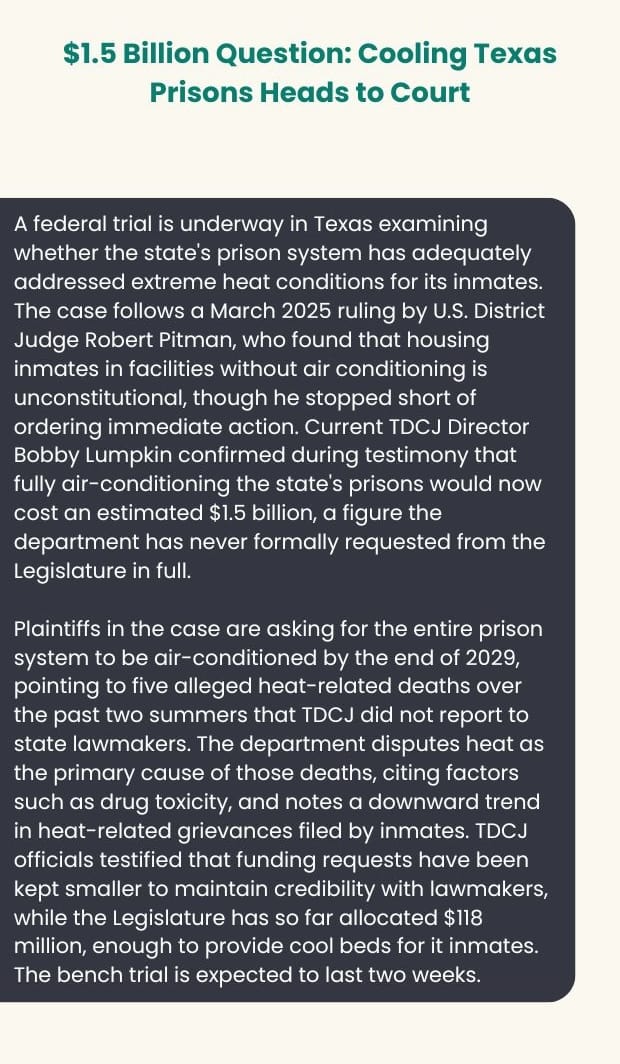
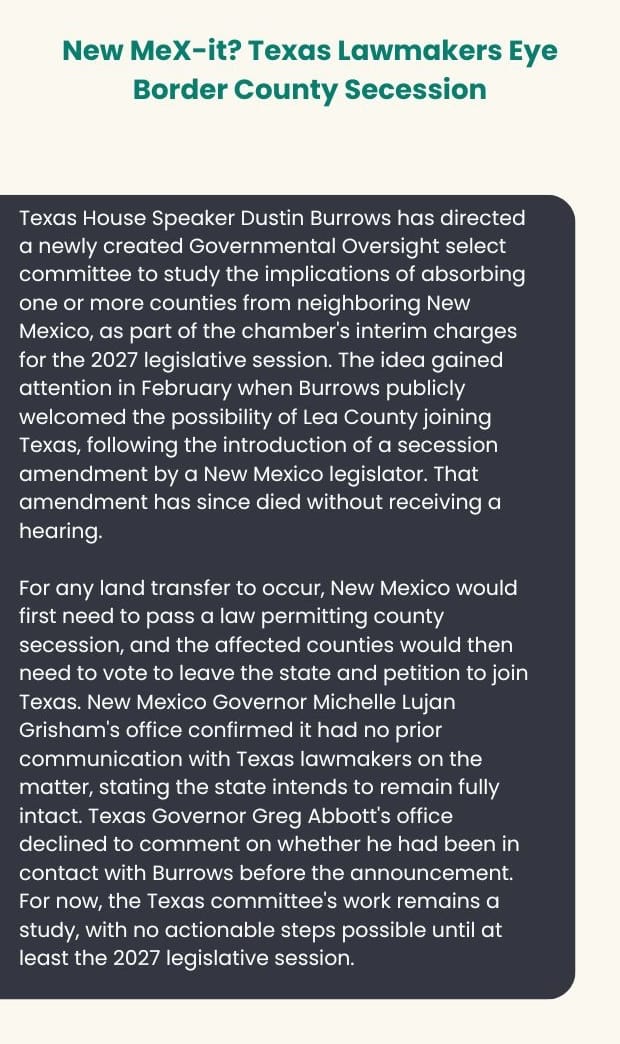
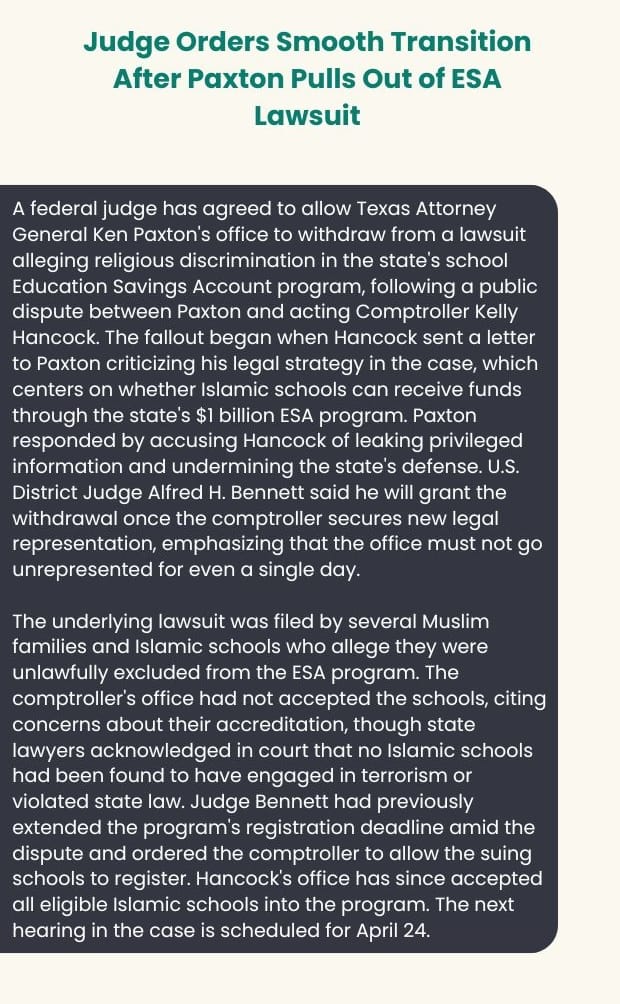
A federal trial is underway in Texas over whether the state's prison system has done enough to protect inmates from extreme heat, with a price tag of $1.5 billion standing at the center of the debate. Texas House Speaker Dustin Burrows has tasked a new legislative committee with studying whether Texas could absorb one or more counties from New Mexico, a long-shot proposal that has already drawn a sharp response from the neighboring state's governor. A public feud between Texas Attorney General Ken Paxton and acting Comptroller Kelly Hancock has spilled into federal court, where a judge is overseeing the fallout in a lawsuit alleging religious discrimination in the state's $1 billion ESA Program.
We hope you enjoyed today’s read!
Stay connected with TXLege News on X and LinkedIn!
Texas Political Spotlight
Welcome back, friends
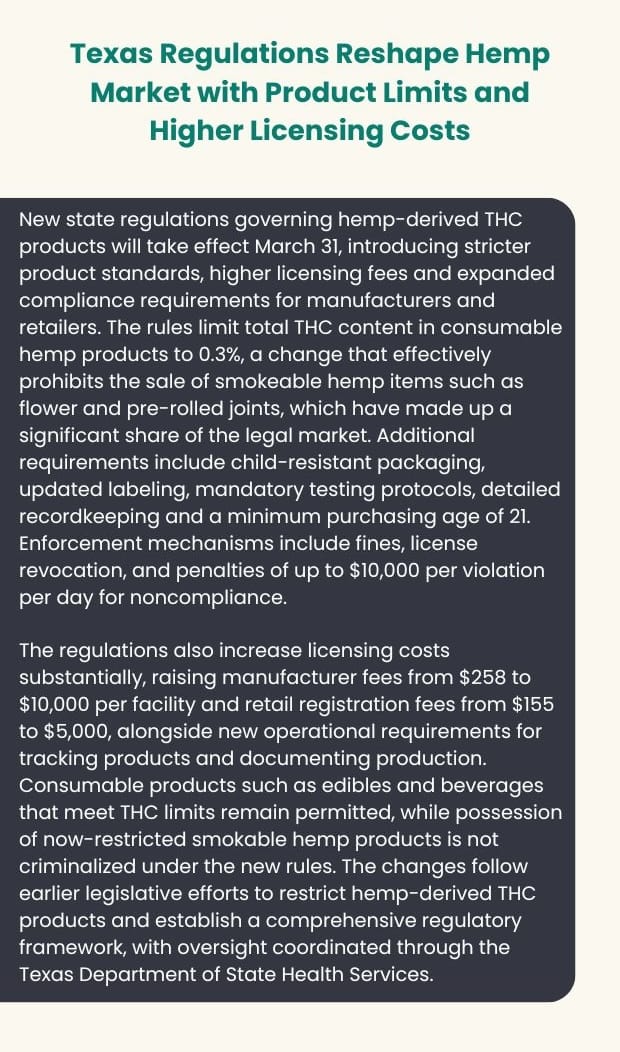
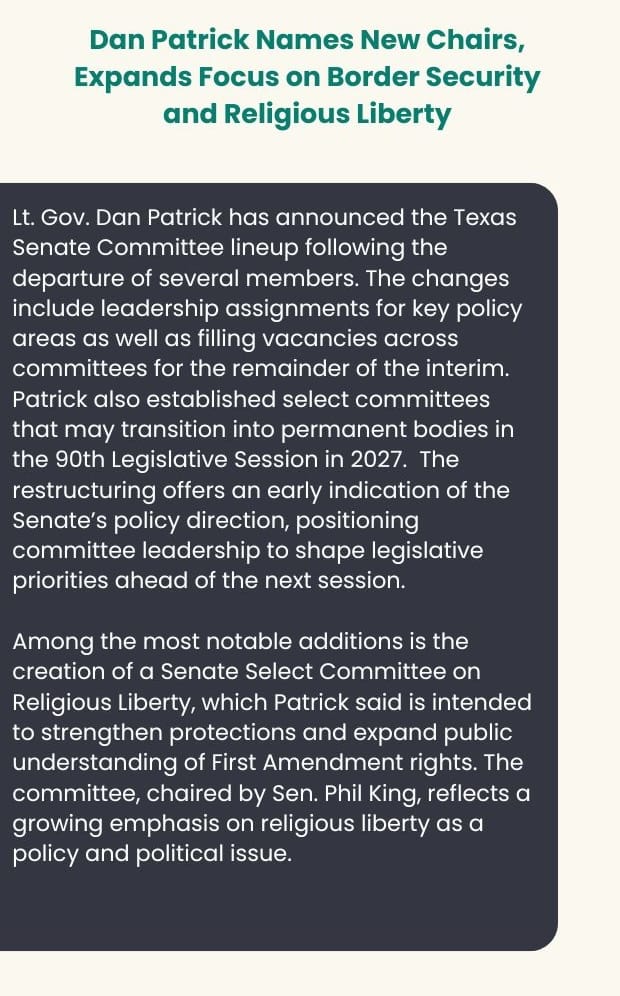
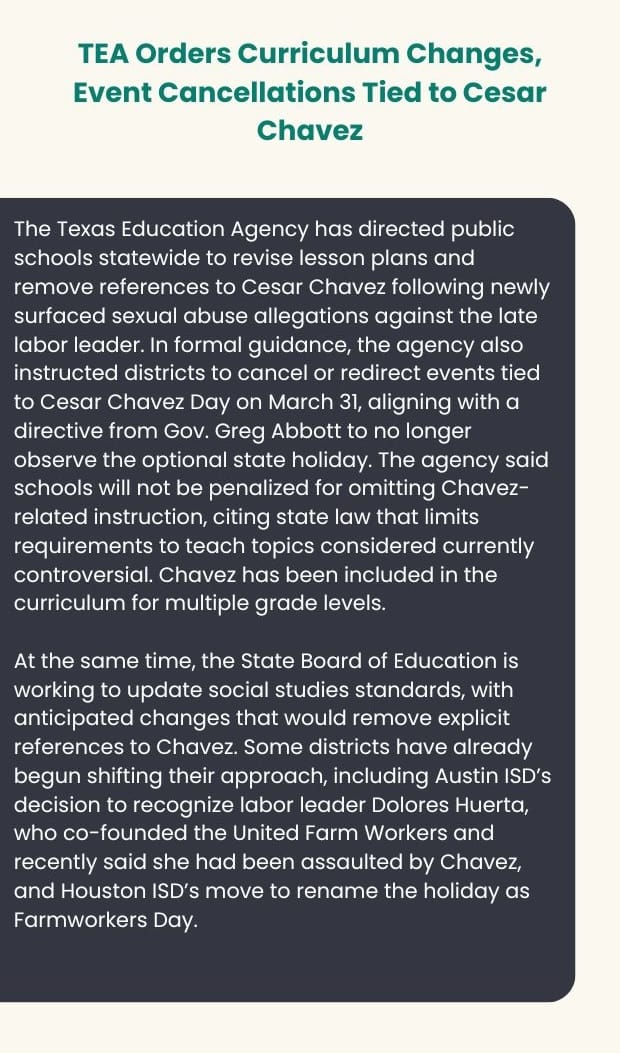
New Texas rules on hemp-derived THC products take effect March 31, reshaping what can be sold, who can sell it and how the industry operates, with major implications for businesses, consumers and enforcement across the state. Lt. Gov Dan Patrick has unveiled the Texas Senate committee lineup. At the same time, state education leaders are moving to revise curriculum guidance tied to Cesar Chavez amid emerging allegations, prompting immediate changes in classrooms and raising broader questions about how schools respond when historical narratives shift.
»»» View official press release from Lt. Gov. Dan Patrick Here «««
We hope you enjoyed today’s read!
Stay connected with TXLege News on X and LinkedIn!
Texas Political Spotlight
Welcome back, friends
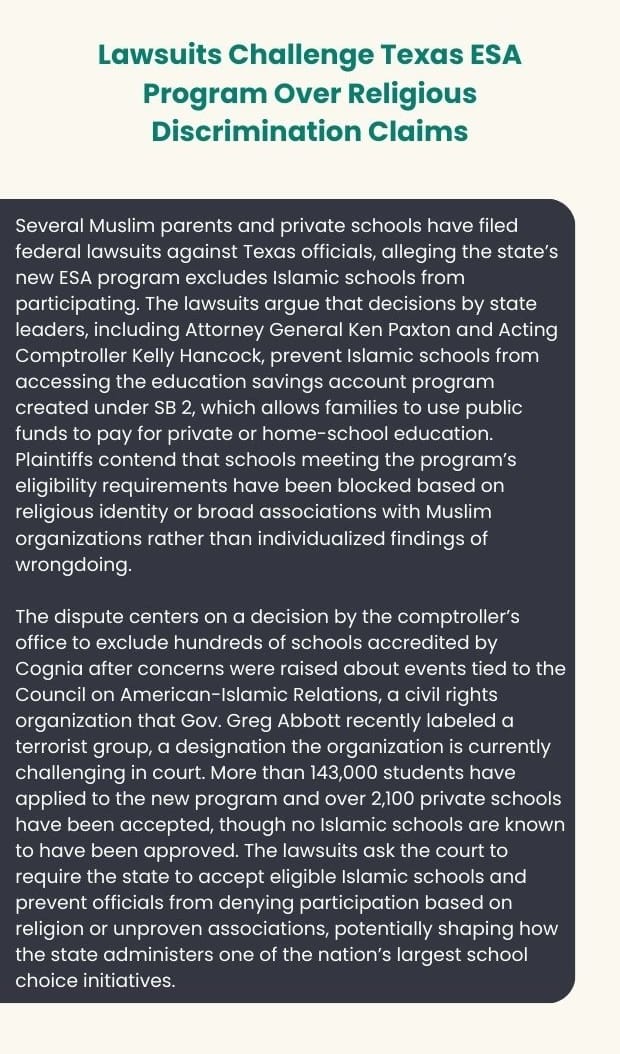
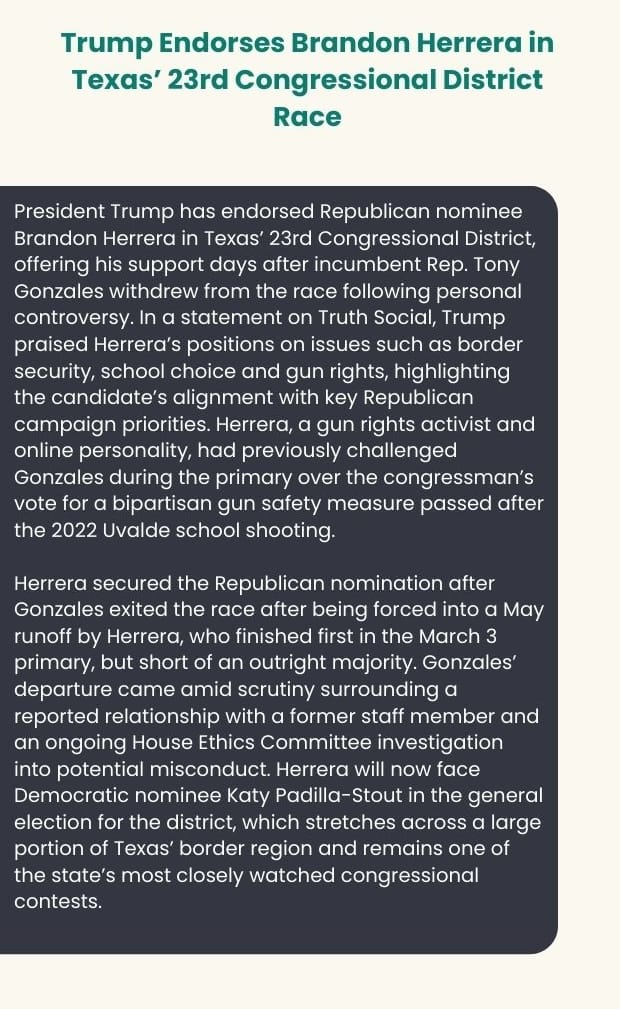
Several Muslim parents and private schools are challenging Texas’ new ESA program in federal court, alleging Islamic schools were improperly excluded from participation in the state’s education savings account system. Meanwhile, President Trump has endorsed Republican Brandon Herrera in the closely watched race for Texas’ 23rd Congressional District following the withdrawal of incumbent Rep. Tony Gonzales amid personal controversy. At the same time, First Lady Cecilia Abbott has announced the recipients of the 42nd Annual Governor’s Volunteer Awards, recognizing Texans whose service and leadership are strengthening communities across the state.

We hope you enjoyed today’s read!


