Redistricting
10/02/2021

What Does a Maximally Competitive Congressional Map Look Like?

TXElects

The Congressional map proposed by Sen. Joan Huffman (R-Houston) draws 35 districts with a Partisan Voting Index (PVI)* of 10 or more – not a very competitive map. Instead, it would essentially lock the partisan representation of the vast majority of voters through the coming decade, which would put all the power in the hands of primary voters.

Two districts – CD23 and CD28 – would have a PVI of +5 for the Republicans and Democrats, respectively. The lone truly competitive district would be CD15, which extends from Hidalgo Co. to the San Antonio suburbs and exurbs. It’s sufficiently competitive that U.S. Rep. Vincente Gonzalez (D-McAllen) is considering running in open CD34, which is much friendlier to Democrats.

Of course, partisan competitiveness was not the goal of the mapmakers. But what if it were? How many competitive districts could be drawn if that were the primary consideration? For this exercise, we set aside the Voting Rights Act, incumbent protection or any other consideration other than we wanted to create as many competitive districts as possible.

We drew 31. All but four of them have a PVI of zero. Three are D+1 and one is D+2. The remaining seven districts are all safe Republican seats with a PVI of R+19 or greater (Incidentally, the Huffman map as introduced has eight districts with a PVI of +19 or greater, split evenly between Democrats and Republicans.).

Max Competitive Congressional statewide map
Max Competitive Congressional Map

You can view our map on District Builder (Max Competitive 2**), an online tool that gives everyone the tools to draw districts and see the effects of adding or subtracting areas to a district. A close approximation of Huffman’s proposed map is also available on District Builder. Keep in mind that the Huffman proposal has already been superseded by the committee report.

Seven of our districts have a Hispanic/Latino majority, and another 22 districts are “coalition” districts where the sum of Black, Hispanic/Latino, Asian and other non-Anglo races collectively comprise a majority. Nine districts have an Anglo majority.

One of the consequences of maximizing partisan competitiveness was the inability to draw a Black-majority district. Black residents do not comprise 30% of any district. This is due to the very high correlation of the proportion of Black residents in a census block to its Democratic lean. No other group is as cohesive, except for Anglo residents in rural counties.

Our map achieves maximum partisan competitiveness essentially by “cracking” not only urban minority populations but also by “cracking” suburban and exurban Anglo populations. For example, Dallas Co. is divided into eight districts, all of which extend into surrounding counties. The most egregious of these is CD30, which stretches from the Tea Party stronghold of Colleyville through southern Dallas Co. and then south to Corsicana and east to Terrell. Our earlier effort to maximize competitiveness extended the district all the way to Tyler, where a pocket of Democratic votes, mostly from Black voters, sits untapped in our Max Competitiveness 2 map. All eight of these Dallas Co. districts are competitive.

Max Competitive Congress map-Metroplex

Harris Co. includes portions of 10 districts, all competitive, only one of which (CD7) is entirely within the county. The others spread into surrounding counties to offset Republican votes there. As we drew it, CD22 is 33% Anglo, 24% Hispanic/Latino, 22% Asian and 21% Black – the most evenly diverse coalition district we crafted.

Max Competitiveness Congress-Harris

Travis Co. includes portions of five districts, all of which are competitive. Heavily Democratic Austin balances the heavily Republican Hill Country (CD25), Republican swaths of Williamson and Bell Cos. (CD17 and CD31) and the Republican territory between Travis and Harris Cos. (CD10). CD21 includes only a tiny portion of southern Travis Co. Most of its Democratic votes come from San Antonio and San Marcos.

Max Competitive Congress map-Travis

Bexar Co. is broken into five districts, two of which stretch all the way to the Rio Grande.
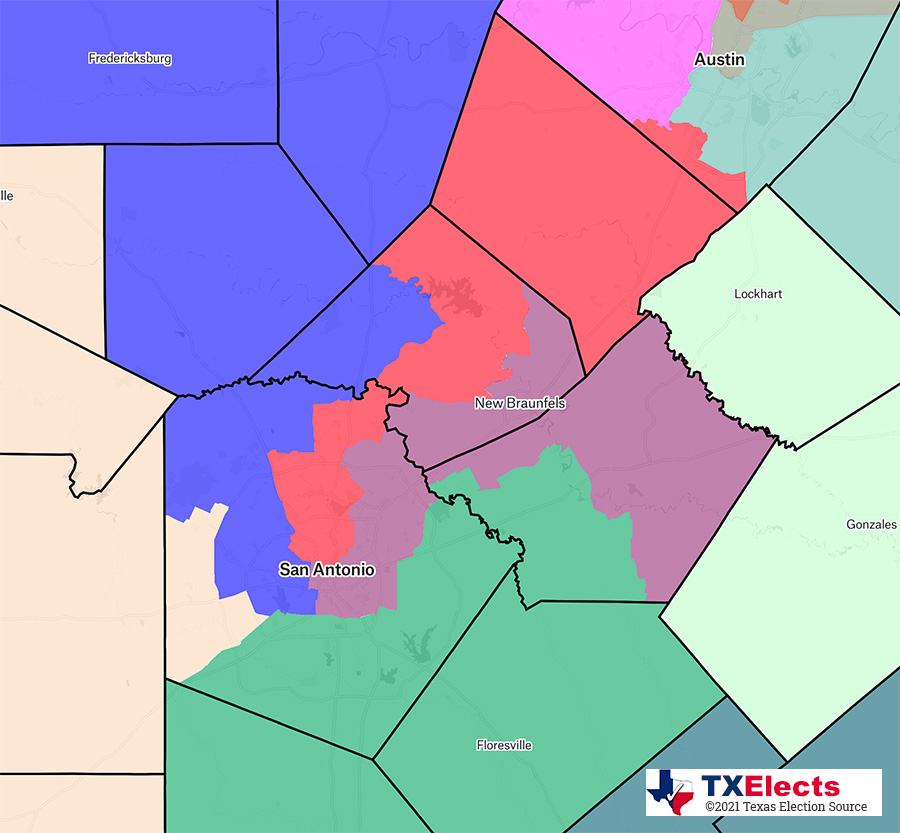
Max Competitive Congress-Bexar

Four north-south districts emanate from Cameron and Hidalgo Cos. All four are competitive. CD15 in our map takes a very similar path northward as the proposed CD15 in the Huffman map. Our CD15 bends eastward and includes Beeville and Victoria; Huffman’s stays north and includes Floresville and Seguin. In our map, Floresville is part of CD38, which parallels CD15.

Max Competitive Congress-So Texas

El Paso Co. is split into two, as are Culberson, Hudspeth and Pecos Cos., permitting the Democratic votes in El Paso Co. to balance out Republican votes around Midland and San Angelo.

Where partisan competitiveness could not be achieved, we grouped counties to form the remaining Safe Republican districts.

Our map splits 41 counties, 12 more than the Huffman map. Our map produces 29 majority-minority districts, seven more than the Huffman map. Neither map scores highly in compactness – 20% for our map and 19% for Huffman’s.

We did not create the map as a serious proposal. It is simply a demonstration of how partisan competitiveness could be maximized and the demographic and geographic tradeoffs necessary to achieve it.

* PVI is a measure of partisan lean calculated based on the 2016 and 2020 presidential elections. It is one of several convenient means of providing a rough evaluation of a district’s likelihood of being competitive. Texas Election Source uses a different calculation based on a broader array of offices, but it’s not convenient. For purposes of this analysis, PVI will suffice.

** This was our second effort at maximizing competitiveness. Our first effort yielded 29 districts. We thought we could do better.

©2021 Texas Election Source LLC

🎙️We Have a Podcast! 🎙️

Bills and Business is your go-to podcast for conversations related to Texas legislation and business. Hosted by Laura Carr, Co-Founder of USLege—an AI-driven legislative tracking software—we bring you in-depth analysis on economic trends, impactful legislation, and key developments shaping Texas business.

Subscribe on Youtube and Spotify for weekly episodes!

🔍 USLege - The Only AI-First Political Tracking Solution ✨

USLege helps you track legislation and find what you need faster from bills, committee hearings, floor debates, and state agency meetings faster.

Say goodbye to tedious tasks!

You can follow USLege on LinkedIn, Facebook, and X.

🤝 Texas Association of Business 📈

Texas Association of Business (TAB) is the Texas State Chamber, representing companies of every size and industry. TAB’s purpose is to champion the best business climate in the world, unleashing the power of free enterprise to enhance lives for generations.

You can follow TAB on LinkedIn, Facebook, and X.

Table of Content
  1. 01 First
Trusted by Government Affairs Professionals and Corporate Policy Teams
Blog & Articles

Read more news

How to Choose the Best Legislative Tracking Software for Your Organization
This is some text inside of a div block.

In today’s fast-paced policy environment, staying informed is a constant challenge. Bills, hearings, and regulatory updates move quickly across jurisdictions, creating risks for organizations that rely on timely information, including the risk of missing important information when relying on manual processes. Choosing the best legislative tracking software is one of the most effective ways to manage legislative and regulatory tracking efficiently, minimize missed opportunities, and strengthen decision-making.

This article walks you through how to evaluate legislative and regulatory tools, compare coverage and capabilities, and understand which features help government affairs professionals and public affairs teams stay informed and a step ahead of rapid change. You’ll learn how to assess software platforms, review vendor performance, and apply a clear framework to guide your organization’s choice.

If you’re exploring modern solutions for policy monitoring, visit the best legislative tracking software to see how advanced systems help professionals track activity and analyze critical information across multiple jurisdictions.

Why Legislative Tracking Software Matters

Every legislative session brings thousands of new bills and hearings across the federal government, state legislatures, and local governments. For government affairs teams and law firms that must monitor state legislation or track regulations, the pace of change can be overwhelming.

Without digital platforms, staff may spend hours each day manually searching databases, reading committee reports, and updating spreadsheets. That process isn’t just inefficient—it’s risky. Missing one act or amendment could affect compliance, advocacy strategy, or even public reputation. Relying on manual tracking increases the chance of overlooking important details in legislative information, which can lead to missing critical updates or changes.

The Challenge of Volume and Velocity

  • Legislative and regulatory tracking spans bills, hearings, amendments, and regulations that appear daily.
  • Strategic decisions depend on access to verified data and real-time alerts.
  • Regulatory developments from government agencies can impact clients and advocacy groups instantly.

The Payoff

Automated tracking saves time, reduces human error, and delivers actionable insights faster. Teams can filter results, share updates, and focus their attention where it matters most—on influencing policy and shaping outcomes.

Key Features and Capabilities to Look For

Choosing the right tracking platform starts with understanding what differentiates effective tools from simple alert systems. Below are core features to evaluate before purchasing or implementing any solution.

Coverage Across Jurisdictions

The best systems provide a broad jurisdictional reach—from federal legislation to state legislative hearings and local government acts. Before committing, confirm whether the platform includes:

  • Federal and state legislation: Bills, amendments, regulations, hearings, and newly introduced bills, with Congress as a key source for federal legislative tracking.
  • Regulatory activity: Notices from agencies and committees.
  • Comprehensive data sources: Congressional records, local archives, and state portals.

Understanding the dynamic nature of Capitol Hill is crucial, as legislative activity and staff turnover at the federal level can significantly impact advocacy strategies and tracking efforts.

If your team must monitor state legislation, check that the vendor’s coverage includes smaller states and municipalities that frequently pass niche regulations.

Real Time Alerts and Notifications

Fast updates are critical for professionals who manage compliance or advocacy campaigns. Strong systems offer:

  • Instant email alerts for bill introductions, amendments, or new hearings.
  • Custom filters for topics, sponsors, committees, or jurisdictions.
  • Real-time dashboards showing where legislation is moving next.
  • Collaboration tools so teams can assign follow-up actions or comments.

With real-time alerts, government affairs professionals and policy experts can respond before deadlines pass—ensuring that organizations stay ahead and fully informed.

Analytics, Reporting, and Insight Generation

Good tracking isn’t just about collecting raw data. It’s about turning that data into useful analysis. A well-built platform helps users:

  • Create trend dashboards showing activity by topic, legislator, or region.
  • Generate reports to brief clients, executives, or advocacy groups.
  • Use artificial intelligence to compare bills, predict movement, or analyze outcomes.
  • Access historical data for longitudinal analysis.

By combining analytics with visualization tools, organizations gain the context needed to make strategic decisions quickly.

Artificial Intelligence in Legislative Tracking

Artificial intelligence transforms how government affairs professionals and government relations teams approach legislative tracking. By harnessing AI, organizations can analyze massive volumes of legislative and regulatory data in real time, ensuring that no critical bill or regulation goes unnoticed. AI-powered tools can automatically identify and prioritize bills that align with an organization’s advocacy goals, generate personalized bill summaries, and even predict the likelihood of legislative movement—all with minimal manual intervention.

For government relations professionals, this means less time spent sifting through raw data and more time focusing on strategy, stakeholder engagement, and influencing policy outcomes. AI-driven platforms can scan every legislative chamber, flagging new bills and regulations that matter most to your organization. These actionable insights empower teams to stay ahead of policy developments, respond quickly to emerging issues, and confidently make strategic decisions. As artificial intelligence continues to evolve, it will play an increasingly vital role in helping professionals track legislation, analyze regulatory trends, and drive effective advocacy across all levels of government.

Ease of Use and Vendor Support

Complex systems often fail because users find them hard to operate. When evaluating tracking software, consider:

  • Intuitive search functions and clear navigation.
  • Vendor training, documentation, and help-desk responsiveness.
  • Implementation timelines and onboarding resources.
  • Integration options with CRM, compliance, or reporting platforms.

The easier the interface, the more likely professionals across departments—legal, advocacy, and communications—will actually use it.

Security and Data Protection

When it comes to legislative tracking, security and data protection are non-negotiable for government affairs professionals and organizations. The sensitive nature of legislative and regulatory data—combined with the need for accurate, up-to-date information—means that robust security measures are essential. Leading legislative tracking platforms employ advanced encryption, secure servers, and strict access controls to ensure that only authorized users can access critical information.

In addition, reputable platforms adhere to industry best practices and compliance standards, safeguarding client data from unauthorized access or breaches. This commitment to security allows government relations professionals to focus on their core strategy and advocacy efforts, knowing that their data is protected at every step. By selecting a platform with proven security protocols, organizations can confidently manage their legislative tracking activities and maintain the trust of stakeholders, clients, and team members.

Integration with Other Tools

For government affairs professionals, efficiency and collaboration are key to successful advocacy. That’s why seamless integration between legislative tracking platforms and other essential tools—such as CRM systems, email clients, and social media monitoring software—is so valuable. Integrated platforms enable government relations professionals to track bills, monitor legislator interactions, and analyze advocacy campaigns all in one place, reducing manual data entry and streamlining workflows.

By connecting legislative tracking with CRM systems, organizations can maintain a comprehensive record of stakeholder engagement, track the progress of key bills, and measure the impact of their advocacy efforts. Integration with communication tools also ensures that teams can quickly share updates, assign tasks, and coordinate responses to legislative developments. Ultimately, these integrations help government affairs teams stay ahead of policy changes, maximize efficiency, and deliver more effective results for their organizations and clients.

Cost, Scalability, and ROI

Pricing varies widely across platforms. Some charge by user, others by jurisdiction. Evaluate:

  • Scalability: Can you expand access as new teams join?
  • Hidden costs: Extra fees for integrations or data exports.
  • ROI: Measure efficiency gains, reduced research hours, and improved regulatory compliance.

The right investment pays for itself through faster tracking, stronger insight, and better policy outcomes.

Building Your Decision-Making Checklist

A structured checklist helps teams evaluate multiple vendors objectively. Consider the following steps:

  1. Define scope: Identify which government levels—federal, state, local—your organization must monitor.
  2. Map stakeholders: Determine which departments, clients, professionals, or legislators need access to legislative tracking information.
  3. Create a scoring system: Rate vendors on coverage, alerts, analytics, ease of use, and cost.
  4. Request demos: Ask vendors to show how their tools track legislation and deliver reports.
  5. Review accuracy: Compare automated alerts to official legislative portals to confirm reliability.
  6. Pilot the system: Run a short test during a legislative session to evaluate performance.

This structured review allows government relations professionals and policy experts to make choices based on measurable evidence, not sales claims.

Common Pitfalls and How to Avoid Them

Even sophisticated organizations can stumble during implementation. Watch for these frequent errors:

  • Assuming full coverage: Some systems exclude local governments or agency regulations. This can result in missing important government actions, leaving you unaware of key legislative or regulatory developments.
  • Overloading users: Too many irrelevant alerts lead to fatigue.
  • Ignoring integration: Platforms that don’t connect to existing tools reduce efficiency.
  • Underestimating training: Teams may resist new systems without clear onboarding.
  • Skipping metrics: Without KPIs, you can’t analyze ROI or improvement.

Avoiding these issues keeps your strategy grounded in real performance data.

Implementation Best Practices and Maximizing Value

Rolling out a new tracking platform works best when everyone understands the process. Follow these steps:

  • Stakeholder alignment: Engage government affairs, legal, and communications teams early.
  • Define taxonomy: Standardize issue tags, committees, and jurisdiction names.
  • Workflow mapping: Assign ownership for monitoring, escalation, and communication.
  • Training: Offer live sessions and short guides to reinforce adoption.
  • Continuous review: Revisit settings each quarter to refine alerts and search filters.

As policy cycles shift, ongoing optimization ensures that your system remains accurate, relevant, and responsive to regulatory developments.

For additional insight on how legislative and regulatory tools operate, review the NCSL’s bill tracking overview, which explains how professionals track state legislation effectively.

Future of Legislative Tracking

The future of legislative tracking is bright, with rapid advancements in artificial intelligence, machine learning, and data analytics reshaping how government affairs professionals and organizations monitor and influence policy. As the demand for real-time, data-driven insights grows, legislative tracking tools will become even more sophisticated—offering predictive analytics, automated reporting, and deeper integration with other advocacy platforms.

We can expect to see greater adoption of cloud-based solutions, enhanced security features, and more intuitive user interfaces that make it easier for government relations professionals to access and analyze critical information. The integration of legislative tracking with CRM, communication, and analytics tools will provide a unified view of advocacy efforts, enabling teams to coordinate strategy and engage stakeholders more effectively.

As the policy landscape evolves, staying ahead of legislative and regulatory developments will be essential for organizations seeking to influence legislation and achieve their advocacy goals. By embracing the latest technologies and innovations, government affairs professionals can ensure they remain agile, informed, and ready to drive meaningful impact in an ever-changing environment.

Texas Political Spotlight
This is some text inside of a div block.

Welcome back, friends

Texas voters approved one of the largest property tax relief packages in state history on Tuesday, raising the homestead exemption to $140,000 and granting new tax breaks for seniors, people with disabilities, and small businesses. In Austin, residents rejected Proposition Q, a plan to fund public safety, homelessness programs, and city facility initiatives through a property tax hike, forcing city leaders to rework the budget and brace for service cuts. Meanwhile, Bexar County voters narrowly passed Propositions A and B, greenlighting up to $311 million in tourism-funded support for a new downtown Spurs arena and upgrades to the Freeman Coliseum grounds.

We hope you enjoyed today’s read!

Stay connected with TXLege News on X and LinkedIn!

Texas Political Spotlight
This is some text inside of a div block.

Welcome back friends,

Former Vice President Dick Cheney, one of the most influential and controversial figures in modern American politics, has died at 84, remembered by former President George W. Bush as a “patriot” whose intellect and conviction shaped decades of U.S. policy. In Texas, the Education Agency announced a sweeping takeover of Fort Worth ISD, the state’s second-largest intervention, citing years of academic underperformance and plans to install new local managers. And in Washington, a United Airlines flight was evacuated after a bomb threat, prompting an FBI investigation that later found no explosives, allowing operations to resume safely.

We hope you enjoyed today’s read!

Stay connected with TXLege News on X and LinkedIn!